Showing posts with label Tax tips. Show all posts

January 5, 2012

Tax Problems for Americans Overseas: Expats Seeking a Simple Life Finding Complicated Mess in New Tax Laws – FATCA and FBAR

It’s beyond the scope of this blog to go into all the intricate details of the new tax legislation passed by Congress that is reeking havoc around the world for Americans living abroad.  Besides, the idea of going into all the tax law details just gives me a headache, how about you Dear Reader?

However, for those of us that are living overseas already or who ponder and daydream about living in a foreign land with beautiful vistas, fresh fruit to be picked off the trees, and a cheaper cost of living (especially medical and dental care) … and I suppose for every fan of House Hunters International, there’s big stuff happening now that’s hurting American expats.

It began as an attempt to collect unpaid taxes by the federal government, where officials were concerned with fighting tax evasion.  Laws were passed.  Yes, they are already on the books.  Now, the IRS is implementing those laws through IRS regulations and there’s the rub.

What’s going on with FATCA, FBAR, and the American Expatriate?

Okay first there are two laws involved here: the Foreign Accounts Tax Compliance Act  (FATCA) and the Bank Secrecy Act.  The Bank Secrecy Act requires American citizens living overseas to report their overseas bank account details each year to the Internal Revenue Service by filing Form TD F 90-22.1, Report of Foreign Bank and Financial Accounts (FBAR)

FATCA requires foreign banks to report account information to the U.S. government on all their American customers and if the banks don’t do this, then the federal government imposes huge fees upon these foreign banks for failing to comply.  Nevermind that they aren’t American institutions and have their own set of privacy laws, financial regulations, etc. 

The banks are reacting by doing things like ditching their American customers rather than mess with the whole FATCA deal.  Some countries are insulted and are ignoring FATCA (like China). 

Meanwhile, FBAR requirements are causing nightmare situations for expats all over the place.   One good article with lots of real life stories appeared this week in The Atlantic.  Entitled, “The FATCA Chronicles: Tales from China, Canada and Estonia,” this is the third in a series of articles by James Fallows discussing the expat situation and the new laws trying to thwart perceived tax evasion by the feds. 

Problems include American expats who are signatories on foreign business accounts that have no American income following through them; same thing with foreign accounts held by foreign-citizen spouses; and those with dual citizenship. 

For details on what this means to expats, check out GlobalTaxHelp’s FATCA and FBAR summary and follow the blog posts at US Expatriate, written by a CPA whose practice focuses on expatriate tax issues. 

April 15, 2010

Tax Day Arrives Today - What Are the Fair Tax and Flat Tax Alternatives to the Federal Income Tax?

It's April 15th once again, and I'm going to avoid that road over by the airport, where the main post office is located -- because we all know there's going to be a line of cars over there today, as folk are mailing their tax returns right on the deadline. 

Like it or not, the government has got to have revenue to keep things running for all of us -- but is there a better way to accomplish that?  We're hearing a lot these days about two options: the FAIR TAX and the FLAT TAX.  I got to wondering what they were, so I went and investigated, and thought I'd share what I found out:

Fair Tax

The Fair Tax is a tax that would be placed on all new goods and services you buy for personal consumption (use). You wouldn't pay the tax until you exceeded a "prebate," which is a monthly amount of personal purchases equal to those tallied to be "the poverty level," so the poor and indigent wouldn't have to pay any tax.

The fair tax would be 23%, which sounds like a lot until you hear the Fair Tax proponents tell you that this reflects the current ratio for federal income taxes -- we pay about that much in income taxes each year on our buying dollars.

Why the proponents say this is great: poor people don't get taxed, but all those folk that don't file income tax returns DO. Criminals (think drug dealers) and illegal immigrants automatically paid their fair share because they're buying stuff at the store just like the rest of us. Meanwhile, we get to keep our gross income. No withholding. No tax payments on April 15th. More cash in the citizens pocket means more purchasing power, which should sound good to everyone.

For more information on the Fair Tax, check out FairTax.org and Wikipedia.


Flat Tax

A Flat Tax is really just throwing out all those different tables on who goes into what tax bracket, and taxing everyone on the same percentage -- it's a Flat Rate Tax.

Households would be taxed at a set percentage of income. Companies would be taxed at another set rate.

Proponents argue that this makes it fair on everyone because everyone is paying the same percentage, or the same tax, and it would exempt those below a certain income level from any tax at all.

For more information, check out Wikipedia.

My Two Cents Worth

I'm no tax expert, not by any means, but it seems to me that either of these options offer a simpler alternative to the gathering of needed revenue for the government than the current Tax Code.  While the flat tax does seem to be popular with other countries, I'm thinking that the Fair Tax seems the better option of the two.  Why?  Easy to administer -- and it corrals all those dollars that aren't getting taxed.

Here in San Antonio, we're all too aware of drug money.  We're close to the Tex-Mex border, and our city hosts the intersection of two major interstates:  IH 10 takes you from the east coast to the west coast, and IH 35 takes you from the country's southern border to its Canadian one.  Drug revenue is huge in the U.S.A., and the Fair Tax means these dollars come into the pot.  I like that idea, seems smart.  And simple.

March 4, 2010

Free Tax Software - Which is the Best Free Income Tax Preparation Software (2010)?

There's lots more free tax software out there on the web than I realized, and there's also lots of great sites that have taken the time to compare and review these offerings, giving you, Dear Reader, the skinny on which is the best deal in free tax preparation software for 2010. 

Here's what I found:

Top Ten Reviews - it's reviewing nine different tax filing software packages - but not the freebies are evaluated, these are the packages you pay for ... still, some good info in this review and I'm providing it here anyway.  (Who wins?  TurboTax.)

Tax - Compare - it's reviewing 4 free tax software packages (TurboTax, H&RBlock, TaxACT, and CompleteTax) and opines that TurboTax is best and CompleteTax is ... well, not so good.

Consumer Search - while they don't tell you all the versions compared, they are pretty bold about recommending TaxACT as the best free tax software out there (it came in 2d at Tax-Compare, by the way).  However, when you read their review of tax software overall, they're all over TurboTax as the best tax software out there.  Go figure.

April 15, 2006

Last Minute Tax Tips

The photo at the left shows a group of folk filling out their 1920 income tax returns at the Internal Revenue Office. Things have changed since then: you can download tax preparation software at sites like Turbotax.com, and you can file electronically. If your adjusted gross income is less than $50,000, then you are eligible for free electronic tax preparation and electronic filing. There's an explanation of how this works at irs.gov.

And, while those taxes aren't due till Monday, for those waiting till the last minute: did you know that you could charge that tax bill on Visa, MasterCard, Discover, or American Express at a reduced interest rate? Pay1040.com has all the answers.

Find out if you are eligible for the Earned Income Tax Credit. Maybe you owe the Alternative Minimum Tax: find out at irs.gov.

What if you can't pay the balance? Don't panic. SmartMoney tells you what to do.

March 24, 2006

Do Expatriates Pay Less in Taxes?

There is a free report from International Living that provides details on the tax implications of living in various countries as an American citizen.

So, does living abroad mean a tax savings to the American expatriate? Not necessarily. There are some countries with low tax rates which may mean savings, such as Panama. There are other countries that have double-taxation treaties with the USA, including France and Mexico.

For a detailed answer to the question, there's a book you can order, The Expatriate's Tax Bible. Or, you can check with a tax professional who works with expatriates - either in the US, or in the foreign country you're investigating. Search Google for "expatriate accountant" and you'll find a list of pros to answer your questions.

March 4, 2006

Do You Get a Tax Credit?

Tax credits are good. They reduce, dollar-for-dollar, the amount of taxes owed. Sometimes, they can reduce taxes so much that the taxpayer ends up with a refund (this doesn't happen with all credits, only those labelled "refundable credits"). Credits include:

The Earned Income Tax Credit -- a refundable credit for low-income working individuals and families. Income and family size determine the amount of the credit. See IRS Publication 596, Earned Income Credit.

The Child and Dependent Care Credit -- credit for expenses paid for the care of children under age 13, or for a disabled spouse or dependent, to enable the taxpayer to work or look for work. See IRS Publication 503, Child and Dependent Care Expenses.

The Child Tax Credit -- credit of up to $1000 for people who have a qualifying child. This credit can be claimed in addition to the credit for child and dependent care expenses. See IRS Publication 972, Child Tax Credit.

Adoption Credit -- credit of up to $10,630 for qualifying expenses paid to adopt an eligible child. The credit may be allowed for the adoption of a child with special needs even if you do not have any qualifying expenses. See the instructions for Form 8839, Qualified Adoption Expenses.

Credit for the Elderly or the Disabled -- credit is available to individuals who are either age 65 or older or are under age 65 and retired on permanent and total disability, and who are U.S. citizens or residents. (Some income limitations apply.) See IRS Publication 524, Credit for the Elderly and the Disabled.

There are other credits available, so read the instructions for Form 1040 carefully, as well as the IRS information at http://www.irs.gov/. For more questions, call 1-800-TAX-FORM (1-800-829-3676).

February 26, 2006

Filial Responsibility Laws - List of States Having Them

States with filial responsibility laws are: Alaska, Arkansas, California, Connecticut, Delaware, Georgia, Idaho, Indiana, Iowa, Kentucky, Louisiana, Maryland, Massachusetts, Mississippi, Montana, Nevada, New Hampshire, New Jersey, North Carolina, North Dakota, Ohio, Oregon, Pennsylvania, Rhode Island, South Dakota, Tennessee, Utah, Vermont, Virginia, and West Virginia.

To look up the actual language of the statutes, here are the citations:

1. Alaska Stat. 25.20.030, 47.25.230 (Michie 2000)

2. Arkansas Code Ann. 20-47-106 (Michie 1991)

3. California Fam. Code 4400, 4401, 4403, 4410-4414 (West 1994), California Penal Code 270c (West 1999), California Welf. & Inst. Code 12350 (West Supp. 2001)

4. Connecticut Gen. Stat. Ann. 46b-215, 53-304 (West Supp. 2001)

5. Delaware Code Ann. tit. 13, 503 (1999)

6. Georgia Code Ann. 36-12-3 (2000)

7. Idaho Code 32-1002 (Michie 1996)

8. Indiana Code Ann. 31-16-17-1 to 31-16-17-7 (West 1997); Indiana Code Ann. 35-46-1-7 (West 1998)

9. Iowa Code Ann. 252.1, 252.2, 252.5, 252.6, 252.13 (West 2000)

10. Kentucky Rev. Stat. Ann. 530.050 (Banks-Baldwin 1999)

11. Louisiana Rev. Stat. Ann. 4731 (West 1998)

12. Maryland Code Ann., Fam. Law 13-101, 13-102, 13-103, 13-109 (1999)

13. Massachusetts Gen. Laws Ann. ch. 273, 20 (West 1990)

14. Mississippi Code Ann. 43-31-25 (2000)

15. Montana Code Ann. 40-6-214, 40-6-301 (2000)

16. Nevada Rev. Stat. Ann. 428.070 (Michie 2000);
Nev. Rev. Stat. Ann. 439B.310 (Michie 2000)

17. New Hampshire Rev. Stat. Ann. 167:2 (1994)

18. New Jersey Stat. Ann. 44:4-100 to 44:4-102, 44:1-139 to 44:1-141 (West 1993)

19. North Carolina Gen. Stat. 14-326.1 (1999)

20. North Dakota Cent. Code 14-09-10 (1997)

21. Ohio Rev. Code Ann. 2919.21 (Anderson 1999)

22. Oregon Rev. Stat. 109.010 (1990)

23. 62 Pennsylvania Cons. Stat. 1973 (1996)

24. Rhode Island Gen. Laws 15-10-1 to 15-10-7 (2000); R.I. Gen. Laws 40-5-13 to 40-5-18 (1997)

25. South Dakota Codified Laws 25-7-28 (Michie 1999)

26. Tennessee Code Ann. 71-5-115 (1995), Tenn. Code Ann. 71-5-103 (Supp. 2000)

27. Utah Code Ann. 17-14-2 (1999)

28. Vermont Stat. Ann. tit. 15, 202-03 (1989)

29. Virginia Code Ann. 20-88 (Michie 2000)

30. West Virginia Code 9-5-9 (1998).

These state laws vary; however, law student Shannon Edelstone, in her award-winning essay (cited below), studied all of the state laws and found that most agree that children have a duty to provide necessities for parents who cannot do so for themselves. The states' legislation also gives guidelines to the courts, telling judges to use a number of factors when weighing the adult child's ability to pay against the indigent parent's needs. Judges, accordingly, have considered such variables as the adult child's financing of their child's college education, as well as his/her personal needs for savings and retirement.

What state had the most court cases dealing with application of its statute? In my search, it was California.


Sources: Filial Responsibility: Can the Legal Duty to Support Our Parents Be Effectively Enforced? by Shannon Frank Edelstone, appearing in the Fall 2002 issue of the American Bar Association's Family Law Quarterly, 36 Fam. L.Q. 501 (2002); my own research using Lexis.Com.

June 9, 2010 Update:  I have discovered that the New York Times has used this post as a graphic without my knowledge or permission. The link to that graphic, which accompanied an article written by Jane Gross in the Times' New Old Age Blog is here:  http://graphics8.nytimes.com/packages/pdf/health/NOA/30states.pdf

I've written the Editor.  I suppose some would say that having your stuff lifted by the New York Times is a backwards compliment. 

Personally, I just want my readers to know that I did this work, I'm not the one who has stolen a blog post here. 

February 4, 2006

No State Income Tax


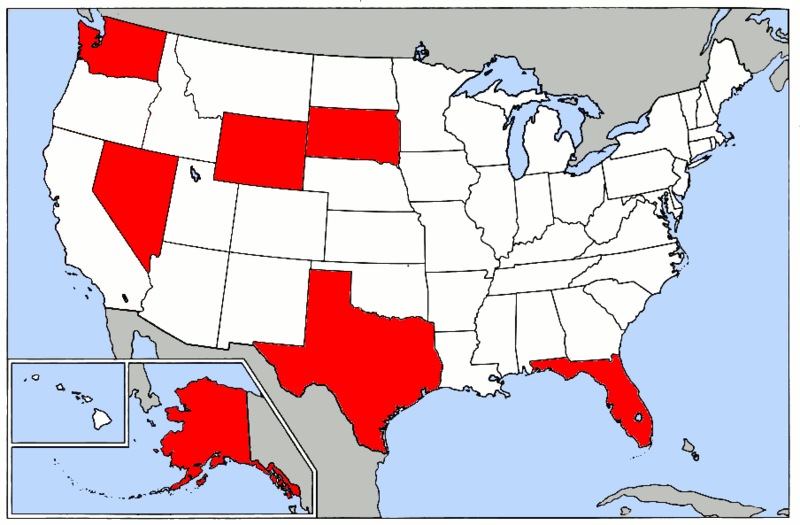
Not every state taxes the income of its citizenry. Just something to ponder if you're considering relocation. Those that don't: Alaska, Texas, Florida, Washington, Nevada, South Dakota, and Wyoming. (Two others, New Hampshire and Tennessee, only tax income from dividends and interest.)

For those that do tax, the rates vary. A comparision chart is provided at tax.admin.org.

(Those states appearing in red do not have a state income tax.)

February 3, 2006

AARP Offers Lots of Free Tax Help


AARP offers online help as well as personal counseling via its Tax-Aide program. Lots of basic questions are answered in its FAQ section. Wondering about your sale of securities, or which form to use? Those questions are answered here.

Across the country, AARP has over 30,000 volunteers at 8,500 locations. (At the site, if you input your zip code, you can find the closest Tax-Aide location.)

Here, IRS-certified volunteers provide both counseling and preparation services to millions of low- and middle-income taxpayers, with special attention to those ages 60 and older. These Tax-Aide folk also can be scheduled to visit with your group; this can be arranged online. Or, you can send in your questions online, and file electronically if you choose to do so.

The cost of all this help? Zip. It's free. All of it.

January 23, 2006

Accurate Deductions for Your Donations

There is a great software package available today, that helps you to determine the proper value of the donations you made during the previous year, for tax purposes. It's called It's Deductible, offered by the TurboTax folk HERE.
Related Posts Plugin for WordPress, Blogger...