Showing posts with label Lifestyle Changes. Show all posts

October 15, 2016

My New Jumbo Coffee Mug Arrives Today!

.
.

I admit it.  I am actually watching the front door, waiting for the mailman.  I'm thinking about getting the dog involved -- let him monitor through the screen.  Seriously,  This is a BIG DEAL.  I'm really excited.

Why?  USPS will be bringing me my new, wonderful HUGE coffee mug today.  Here's what it looks like in the Amazon site:


 It's the simple things, people.  


This mug holds FIFTY-TWO OUNCES.  That's right.  52.  It's promised to be SIX INCHES high.  Wow.

Of course, Snoopy hugging Charlie Brown is sweet.  Makes me happy.  And the message is a good one:  "Lots of Love."

But the thing that is making me want to dance is its capacity.  I want a big coffee mug.  A BIG one.

Why such a jumbo mug?


Here's why.  I want a mug with some extra space on top so I don't slop liquid onto my desk while I try to drink with one hand, type with the other, and never let my eyes leave the computer screen.  It's a bad habit.

(Odds are high this will happen if I'm laughing at something online.  Things like this.)

Plus it can be a soup mug.  A tea mug.  Water, sure.

Maybe it will hold iced tea for me.  Lord knows I'm tired of drinking iced tea out of a mason jar, and that's the only option if you want to hold something that's glass and 24 oz or more these days.

Go ahead.  Look for yourself.  No iced tea glasses that hold 24 ounces, made of glass.  (I don't drink out of plastic.)

The secret: it's my reward.  


Here's the secret:  this big mug is a REWARD.  I've learned that to make new habits, it's important for me to have rewards.  After all, the bad habits reward me in some way or I wouldn't keep doing them.

So I get this pretty Snoopy Hug Mug today because I've checked off stuff in my Planner Trackers and I've earned it.

Makes me happy.  The Hug Mug.  The reward system.

It works for me. I am a child. I am not ashamed.  LOL


September 30, 2013

The Shopper’s Thrill of the Great Bargain Find: Dollar Tree and Great Books (For a Buck)


 I’ve been living the Voluntary Simplicity lifestyle for many years now, but that doesn’t mean that I’ve lost that thrill of stumbling upon a great bargain while shopping. It’s just that the store names have changed, and the amount that I’m willing to pay is lots (LOTS) less now.

That zing in your heart strings, or purse strings, when you find something great for a low price? It’s still there.

Like it was for me last week.

Go back with me, Dear Reader, as I was pushing my little green shopping cart through the aisles of my local Dollar Tree, which in my opinion is the nicest dollar store out there. (At least in my neck of the woods, San Antonio.) Sure, there’s the need to eagle eye the products here, as in any bargain paradise (be it thrift store, flea market, garage sale, or WalMart) - you have to discern quality from crud.

Dollar Tree is My Favorite Dollar Store -- I Shop Dollar Tree Once a Month for Bargains

There are quality items to be found at Dollar Tree, and the reason that I prefer this chain to the others is two-fold: if I pick it up, I know it’s $1.00 or less (unlike some other “dollar” stores) and there’s more quality stuff at the Dollar Tree chains. At least, this has been my experience. Plus, they’re clean and their workers are friendly and helpful.

I visit Dollar Tree once a month without fail because I find great things there, like this week: 

  1. Brillo sponges (not pads), blue, with a scruffy surface on one side (package of two for a buck). 
  2. Index cards (200/$1.00)(I love using index cards for lots of things, it’s Old School, I know). 
  3. Plastic flowers for my outdoor wreathes (amazing quality, these plastic blooms - very slow to fade). 
  4. Betty Crocker kitchen stuff (got a primo pasta spoon for $1.00). 
  5. Baskets and bins (sweet, big reed basket for a buck - perfect for a gift basket). 
  6. Gift bags (this store doesn’t have the great selection I have seen in other D-Trees, but big bags for a buck is still nice). 
  7. Tape (got Scotch brand clear tape, enough to last me a year at least, two rolls for a buck). 
  8. Del Monte canned vegetables (two regular cans for a buck). 
  9. Dog toys (I don’t buy their edible offerings, but the small stuffed toys are safe and my pups love them - for the 30 minutes it takes for them to tear them apart outside in the grass.) 
  10. Books. That’s right, Dear Reader. BOOKS. 


My local Dollar Tree has some wonderful finds - and I thought I’d share with you the books I’ve bought this month at Dollar Tree: 


Is This Unfair to the Author? Geez Louise, I Hope Not 

I’m not the only one who has discovered great reads at the dollar store. Lynn Viehl writes of buying up some of her author/friend’s books upon discovering them at a dollar store in her April 2005 blog post - and she explains the reasons why finding books in a dollar store might make an author cringe.

 I love authors, I love books, I don’t want to hurt writers in any way. However, without Dollar Tree I would not have known about Richard Lupoff - nor would I read Linda Fairstein (even though I have heard of her name before).

Are these writers making money off my Dollar Tree buys? Nope; these are “remaindered remainders” as Viehl explains. Jance, Fairstein, Evanovich, Briggs, and Lupoff will make no more from their artistry and hard work on my copies than if I’d borrowed their books from the library.

However, they’ve gained a fan in me through DollarTree, and that’s got to be worth something, right? Especially when you consider that these are all series reads, where I’m going to be searching for the rest of the series? (Well, except for Plum. I’ve got almost every Stephanie Plum already.)

Plus, I like to think it’s better to scoop up these great finds at the Dollar Tree than to leave them there. I mean, the only thing worse than finding these books at the dollar store would be to discover that no one bought them there, right?

June 6, 2012

Lifestyle Success: What Does That Mean to You?

Sheep waiting for a train.  Look familiar?

I ran across the phrase "lifestyle success" somewhere recently.  Can't remember where. Twitter?  I googled it of course. (Is that a recognized verb yet?  You know it will be if it's not already.)

Lots of different things popped up in the search results but no one theme.  There's not a movement towards "lifestyle success" like there is towards "voluntary simplicity" for example.

What I found - or to be more accurate, didn't find - gave me pause.  Why not?  Why aren't there lots of places on the web discussing lifestyle success?  Isn't that part of your decision-making?

Seems to me that in this American culture, we've all spent way too much time letting other people and other places decide for us what lifestyle success means.  It's got us in lots of trouble.

What is lifestyle success? 

What does it mean to you?  Who are your role models for successful living?  (Is it really and truly the Kardashians?)

January 3, 2012

Is Candy Spelling The Ultimate Simplifier? Maybe. Sorta. Kinda.

I don’t watch reality television much, but I surfed by this show yesterday – a repeat of HGTV’s Selling Spelling Manor

Wow.  Aaron Spelling’s monster mansion – Spelling Manor – has been sold by his widow and she’s moving to a Century City condo and getting rid of an amazing amount of stuff.  Anyone downsizing or who has downsized can find something with which to identify here. 

Admittedly, there’s much to be said that all of this is the Anti-Simplicity lifestyle.  True, so true.

However, this woman has undertaken a major life change and she’s gone through all those same pangs other simplifiers have:  letting go of the vase that has memories but needs to be tossed; boxing stuff for donation; giving away things that you’ve discovered in the attic stash to someone who’ll love them. 

Look, this country is in a depression and we all know it even if so many are too afraid to use the word.  Is it the Greater Depression?  I don’t think we know yet.

However, when so many are having to scale back and scale down, maybe knowing that Aaron Spelling’s widow Candy has vacated Spelling Manor to live in a condo the size of her former attic may help them feel they are not alone.

Just don’t ask about the slabs of pink Italian onyx going into the kitchen or the private swimming pool being built on the 42nd floor. 

Happy week, Dear Reader! 

November 7, 2011

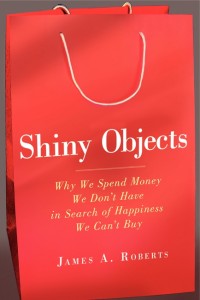
Blog Tour for Baylor Prof Jim Roberts New Book, Shiny Objects

I was recently invited to join a blog tour for a new book that has just been published by HarperOne this fall entitled Shiny Objects: Why We Spend Money We Don’t Have in Search of Happiness We Can’t Buy.  
Written by James A. Roberts, professor of marketing at Baylor University (which is about three hours due north from me on Interstate 35, up in Waco, Texas), it sounds like a great read from someone who has been studying consumerism and consumer behavior for awhile now.  (Check out his online bio here.)

I agreed to read and review the book because I liked the idea of learning what a noted academic with a reputation for studying the "dark side" of American consumerism / marketing had found.  Will Dr. Roberts have anything nice to say about voluntary simplicity?  Will he have any interesting facts and figures about all that ridiculous excess we see everyday (yes, Kim Kardashian was in the news again).

My review will be posted here on December 1, 2011.  It's part of the November 2011 TLC Blog Tour. 

Meanwhile, Dr. Roberts has a blog too, if you're interested ....


October 6, 2011

WSJ Writes of "Forever Frugal" Trend - But Misses the Point That Many Choose Frugal as a Better Lifestyle

In the Wall Street Journal today, there's an article written by Ann Zimmerman entitled, "Frontier of Frugality: Retailers Face Reality That Many People Can't Trade Back Up," and it's filled with information from the American retailers' perspective.  WalMart is experiencing lots of shopping tied to when folk get their paychecks; retailers are seeing lots of shopping with coupons; people aren't jumping to buy premium labels like they used to do.

I find it interesting that there's something missing here (though they tip their hat to this at the end of the piece):  the reality that living simply is a lifestyle choice for many.  For others that have had to change their lifestyles because of unemployment, illness, or just fear that their stock prices are going to crater, it can come as a very nice surprise that living differently is not so bad.  There are people in this country who were forced into frugality by a sudden change in circumstances and are sold on not going back to their old ways, even when they can do so. 

Couponing feels good for those who do it.  It's a rush to save a buck - today on Coupon Mom's email, for example, I saw free Colgate toothpaste and free Cover Girl cosmetics at Target; 6 freebies worth $41 at RiteAid; and 5 freebies worth $52 at Walgreens (she's got lots more deals if you're interested). 

Heck, I want my free Colgate toothpaste at Target -- and it's not because I'm scrimping pennies here, it's because it's FREE.  It's like a little gift, a little treat.  To Reba, From Target.  I like this. 

I like free.  You probably do, too. 

I also like the idea of saving money on my food budget.  But I'm not doing this because of the money.  Long ago, I would spend a shocking amount of my disposable income on fast food or restaurant fare.  It was not good for my pocketbook.  More importantly, it was not good for my BODY.  Now, I shop with a list and a menu planned out -- and I save lots of dough.  Bigger deal: I know what I'm eating.  I'm eating organic, I'm not cooking in aluminum, and I'm washing my lettuce. 

If I do this near a payday, are retailers thinking that I'm cutting back because of the economy?  Maybe.  And, sure, some folk are. Times are tough, and there are lots of people in financial distress in this country.

I don't know that they are all setting around, depressed that they can't buy retail, though.  Which is part of the tone that I read in the retailers' discussion. 

I have changed the way that I spend money because I have found a higher quality of life by doing so.  I am not alone.  My grocery bill is less, not because I'm money-motivated, but because I'm eating fresh food, I'm cooking at home, and I'm not falling prey to advertising siren songs. 


Does this make me "forever frugal"?  Yes, I think so.  Does this mean that maybe Americans are sick and tired of being endoctrinated into materialism?  We'll see. 


September 7, 2011

Simplifying Your Thoughts: Simple Living Means Fighting Against Stress and the Thoughts that Cause It

Tonight, there's the big Republican debate between the presidential candidates and tomorrow, President Obama is going to address the nation on the unemployment crisis - and media rumors are that this will include spending more money.  Lots more money.

Next week, we honor the 10 year anniversary of 9-11.  Last week, we had hurricanes on the East Coast and earthquakes on the West Coast, and even as I type this, hundreds of thousands of areas of beautiful, piney hillsides near Bastrop, Texas (not that far from me, as the crow flies) are burning in an uncontrolled fire.  Was it caused by the drought? By arson?  What about all the wildlife and the homes and the families?

The Scream - Edvard Munch


It's all cause for stress.  

Stress, big stress.  And that's before you take it down a notch and start wondering about your own circumstances.  Finances, health, relationships, savings, investments, rising prices, what the future might hold.

There is a lot to think about, and lots of people are swirling those thoughts around in their minds without realizing that you have the power to decide what you will think about -- and that you need to do this.

It's accepted by most everyone these days that stress will make you sick.  Keep it up, and it can kill you.  (For details, check out lots about acute stress and chronic stress at WebMD.)


And what is stress?  It's your body reacting to what you are thinking.

Simplifying your life involves more than being frugal with your purchases or going green with your environment or becoming vegetarian in your diet ... simple living means having peace and joy and strength in your attitude.

How do you do that?  You become proactive about what you are thinking about and you stop letting your mind run willy-nilly over whatever scary things it wants to ponder.  Yes, you can do this and it doesn't mean that you become brainwashed or live a zombie's existence.

Simple Living Between Your Ears:  How to Fight Stress With Simplicity

I don't do this as well as I'd like, but I'm much better at it than I was long ago.  Here are some of the things that have worked for me:

1.  I stop myself every so often, and pay attention to the thoughts that have been bouncing around in my head.  Am I worrying about something?  Am I angry about something?  Am I afraid?  Then, I take hold of those thoughts and resolve them.

2.  I speak out loud to myself if this is needed.  For example, I forgot to mail in my car registration and here it was, September, and I've suddenly got an expired tag on my windshield.  My thoughts just baked themselves into a big pie of pressure, and once I realized that I was fretting about this in my head, it all stopped when I said to myself, "I will not get a ticket on the way to getting my car sticker, and if I do, then I'll just pay it.  This isn't worth getting upset over, I'll just deal with it - whatever happens." 

3.  I don't watch TV news, I read my news online.  Maybe it's still inflated and spun, but it's less stressful for me than all those talking heads who seem to vie for who can be more thrilling, for lack of a better word, as they ramble on about the latest horrific event.

4.  I pray and I read my Bible, renewing my mind with scripture.  There's a reason why so many have read this book for so long, there is true comfort and strength in its pages.  I think even non-believers can find good counsel in words like these:  "[a]nd now, dear brothers and sisters, one final thing. Fix your thoughts on what is true, and honorable, and right, and pure, and lovely, and admirable. Think about things that are excellent and worthy of praise." (Phil 4:8 NLT).

5.  I read about stress and thoughts to learn more about how thoughts do impact my physical health.  There's lots on this:  medical research (see this UCLA study); books on brain function and stress (see Who Switched off My Brain by Dr. Carolyn Leaf); and books on how diet and exercise are powerful tools against stress, promoting clear thinking and proper hormone balance (see the Hormone Diet by Natasha Turner ND).

One of the great things about living simply is knowing that you can control your lifestyle - even if there are others that don't understand why you are choosing that different drummer.  A big part of that change is internal, becoming a person of independent thought.

Some Days Will Eat You, Some Days You'll Eat the Bear.  

As Jane Armatrading once sang (listen here), some days the bear will eat you, some days you'll eat the bear.  We're all a work in process.

Hang in there, fight that stress, and if you need to see it on the screen, remember this:

Everything is going to be alright.  

(image from Wikimedia Commons, public domain)


June 17, 2011

The Dangers of Sitting Too Much - It Can Kill You

This graphic demonstrates the dangers of sitting at your desk too much and too long.


I've started using a standing desk for a least a part of my work day, and I really enjoy it.  A friend told me that Ernest Hemingway always used as standing desk and I found this photo of Hemingway posing next to his standing desk (here) - cool, right? 

Me, I wasn't influenced by Ernest Hemingway.  It was much more basic:  I got the standing desk because I didn't like sitting at the keyboard for long periods of time (in the words of author Robin Lee Hatcher, I was getting "numb butt"). 

I also appreciate the warnings that are now coming out like this one at Boing Boing:  sitting without getting up for breaks is bad for your body. As in, sitting for many hours at a time, as a routine practice, is extremely bad for you and causes all sorts of problems with your gastrointestinal system, your heart, and other things.  Beware.

So, standing desk or not, get up if you're at a computer right now and move - or at least, stand. 

May 25, 2011

The Refrigerator List : Birds, Bats, and the Occasional Beast

The old man next door, so old that his skin is almost translucent and his hands look like gnarled twigs, loves his back yard.  When he's not sitting outside on his porch, you can see his long white head watching things as he sits, drinking forbidden coffee, at his kitchen table.  An Albert Einstein haircut, a quiet smile.

A great neighbor. 

It's nice to see him roaming around early each morning, refilling his hummingbird bottles and squirrel feeders and putting out food for the feral cats.  Yes, even though we all know that that feral cat food also attracts our neighborhood raccoons and possums - when they're not dining on finds in the alley garbage cans.  (I've heard that mice and rats like this stuff, but our herd of wild Tom Cats keeps us from having that problem.) 

It's because of our neighbor that our family has found another fun experience in simple living.  We've become aware of nature in a new way.  Not from growing our own little veggies or waiting for rain, but from all the creatures that routinely come to visit our white-haired neighbor.

We've created a Refrigerator List.  Rules are you have to see something at least three times before it gets to go on the List; however, you can note sightings of which you're keeping track.  (Right now, we've seen a black bird with a yellow beak, but we're not sure what it is.)

It's got the kids on alert in the evenings after dinner and it's fun to researching some strange birds and things we've spotted (escapees from the zoo?); and we're listening in the quiet to all the small sounds that are really there in the dusk.  It's not really all that quiet, if you take the time to listen.

May 24, 2011 List

Red-shouldered Hawk (we see this guy so often we've named him Harry)
Mockingbird
White-winged Dove
Pigeon
Sparrow
Cardinal
Blue Jay
Grackel
Bell's Vireo songbird
Raccoon
Yellow-headed Verdin
Scissortail
Hummingbird
Mexican Freetail Bat
Thrasher
Squirrel
Robin
Western Kingbird
Feral Cat
Ladder-Backed Woodpecker

looking at: black bird with yellow beak, white birds (big) that fly overhead in pairs, brown noisy squirrel-like animal - chipmunk?

October 19, 2010

Where's The Note? Facing Foreclosure, You May Want to Check Out this Site ASAP - or NOT

Where's the Note? is a website published by a group of organizations (see their logos at the bottom of the page, you'll have to search for their actual sites -- they don't link to this new web site) that's getting lots of media attention.

Go to Where's the Note and you'll get background information on foreclosure issues (things like the definition of a mortgage note) as well as lots of direction on how to fight your impending foreclosure due to the apparent idiocy involved in fast-tracked foreclosure processes by financial institutions across the country.  Better known at this point as "foreclosuregate," in case you haven't been reading the news lately. 

Of course, there are those that are arguing that even if there's a paperwork mess resulting in a title nightmare, if the borrower could not pay the note, then legally Where's the Note gives them action, but morally nothing's changed.  Folk like Mike Konczai are writing about this twist on the growing news story, and I'm happy to see it. 

Because while there are those (including at least one member of Congress) that have advised homeowners to squat, staying put in their homes until the paperwork mess gets sorted out, I gotta wonder if that's best for the home owner. 

It's far from a peaceful life, squatting.  Waiting for the shoe to drop - and unless you get a windfall, then you're setting there knowing you can't pay what you owe, so eventually that's a bell that is gonna ring.  Squatting is not a guaranteed winning Lotto ticket.

Plus, it keeps you from pulling up stakes and moving forward.  And forward is good.  So you join the millions of Americans negatively impacted by this depression, ahem, recession?  So you move to a rental, a forced downsizing of your life?  Is this really and truly so horrible? 

Maybe not, Dear Reader.

Many folk are scared of the simpler life, only to be very pleasantly surprised.  Because a simpler life is a better one.  Whether you voluntarily pursue it or it's thrust upon you, either way -- it's freeing not to be burdened with so much material stuff.  A new chapter in life may mean a second chance to pursue a dream, move to another location, get rid of that dining room set you hate and never use. 

So, while Where's the Note? sounds awfully friendly, I gotta wonder if it's worth all that angst to avoid the eventual New Chapter in Life.  Second chances are sweet, no matter how you come by them.

October 8, 2010

Caretaker Services - Ever Thought of Being a House Sitter or Caretaker in Some Faraway Place?

For 28 years, The Caretaker Gazette has provided a nice service (for a small fee, of course): putting together responsible individuals interested in protecting the property of another as either a sitter or caretaker, with those who need help with their real estate or vacation homes.   Other similar sites include Caretaker Jobs and Indeed

Now some of you may have learned of caretakers in a bodice-ripping romance novel or paperback spy thriller, but others may have become acquainted with the idea of staying in someone else's house - or ranch, or beachside home, etc - from actual success stories.  It's an arrangement that can be very beneficial for everyone concerned.

At the Caretaker Gazette, you can scan lists of prospective properties as a potential caretaker or house sitter, or alternatively, review profiles of those interested in being placed in a caretaking role.  Caretaker Jobs offers analogous information.  Indeed expands to include other types of employment, including things like animal caretaking with the National Parks Service, etc. 

Savvy Way to Financial Recovery?

True, this isn't for everyone -- but for some folk, and you may be one of them Dear Reader, it may be a great way to travel economically or to recover from a financial downturn. 

After all, there are positions (consider the "estate manager" ad shown on the home page of the Gazette) where not only do you live rent-free, you get a small monthly stipend.  If you've got a spouse that works, or you can earn addition money somehow while fulfilling your caretaking duties, then this might be a simple, savvy way to recoup some losses. 

Something to think about, right?

September 21, 2010

Hoarding: a Lifestyle in Opposition to Simple Living

I admit it, I do catch the occaional episode of Hoarding: Buried Alive on TLC TV.  I couldn't tell you when it airs, but I can tell you that everytime I watch the show, it makes me get up and dust or vacuum or do a load of laundry.  Something.  Maybe part of this is because (personal revelation, dear reader!) my mother, looking back, was obviously a hoarder.  So was my first husband's mother.  Wow, there's some food for thought.

Me?  I don't hoard.  Maybe living this lifestyle of voluntary simplicity in some way is reacting to that background - that's sounding plausible.  All I know is that organizing and simplifying seems smart and wise and it's a peaceful, joyful life.

Hoarding - The Reasons for It

As a result of the show, and as I pondered this personal connection with hoarders, I did go surfing around investigating hoarding.  I learned hoarding is a compulsion, with both psychological and physical components.  I learned that lots of professionals discuss anger and anxiety as emotions felt by haorders when faced with the idea of throwing anything away.

I'm not arguing with any of that -- from my experience, this all sounds true.  However, from my experience, there's something that isn't being discussed here.  From what I know of hoarding, it's a twisted way of dealing with a major loss.  It's a grief thing.  It's got a depression component and a thread of denial runs through it, but at its core - its a strange way of fighting against loss. 

Why share this with you, Dear Reader?  Because There's Simplifying Lesson Here for Us All

In the process of simplifying your life - be it downsizing, going green, living frugally or living slowly or moving to a one-income household, or expatriating - and there are lots of varieties of simple living, some of those hoarder reactions seem familiar.

There's the stuff.  Stuff you don't want to get rid of, even if you don't need it and will never use it.  There are all those boxes of memories - the kid's school papers, your old college textbooks - that need to be culled. 

Letting go of stuff is hard.  It involves loss.  Simplifying is hard.  There's an emotional component to the process.  It's worth it, but in no way is it easy.  Simplifying your life may not be simple at all. 

God bless you, Dear Reader.

Doctor Mark Hyman Decries Conventional Medicine in HuffPo: The Rising Awareness of Lifestyle Medicine

Dr. Mark Hyman (M.D.) practices medicine and writes bestselling books (he's made the New York Times Bestsellers list four times so far). Dr. Hyman also founded The Ultra Wellness Center, and is considered to be a world-wide leader in "functional medicine" - so when he writes an article for the Huffington Post (the top blog in the country per Technorati), people pay attention. 

The article is entitled, "Millions Die Due to Withheld Medical Treatment" and if you can't read it at the link (it will be archived at some point), feel free to check Dr. Hyman's website or contact me -- I've saved a copy in OneNote because I don't want to lose it.)

Practicing Physician Claims Conventional Medicine Corrupted by Greed

You should, too.  Why?  Because Dr. Hyman is standing up against a huge contingent of his peers when he writes that conventional medicine today is corrupt: that by its co-dependence upon the big pharmaceutical companies, the true cures for such major diseases as diabetes and heart disease lies in lifestyle medicine

What is Lifestyle Medicine?

Since lifestyle medicine isn't as profitable as conventional methods, it's being ignored according to Dr. Hyman and the result is akin to the Tuskegee Experiments of the 1920s (and if you don't know about this  horror, it's worth your time to stop and read what Dr. Hyman's written - just to learn about this).  

Dr. Hyman's providing lots of information on the web to help people - his website is great, so is the UltraWellness Center.  For example, check out his free series of articles online, "7 Keys to Ultrawellness."  Great stuff in here. 

Lifestyle Medicine Incorporates Simple Living.  Wow. 

Dr. Hyman promotes many of the things that simplifiers value.  Things like eating whole, fresh, organic foods.  Foods that you cook yourself in ovens and on stovetops.  Avoiding bad stuff like high fructose corn syrup and mercury.  Exercising.  Getting enough rest.  Avoiding stress.  Drinking lots of good water.  Taking vitamins. Taking herbs, too. Understanding detoxification. (Did you know that internalized stress can make you fat? Wow.) 

Want to Learn More About Lifestyle Medicine?

To learn more, check out his personal site or Dr. Hyman's UltraWellness website (where he offers a free ebook and lotsa free videos), follow him on Twitter (http://twitter.com/markhymanmd), or surf around for "lifestyle medicine" where you'll find good sites to learn from, including: 

American College of Lifestyle Medicine
Harvard Medical School's Lifestyle Medicine Institute
The Institute of Lifestyle Medicine

September 1, 2010

FOXBusiness Offers 7 Steps to a Single Income Family: Is Downsizing Becoming Acceptable?

Today, FoxBusiness has a great article entitled, "7 Steps to Becoming a One-Income Family" that really does give substantive help in moving from a two-income household to a one-income family.

What I like best is the end of the article, where the expert points out that American society predominates with instant gratification and a pressure to spend - but that the ability to simplify things is doable, and he appears to say there is power in it.

Which those of us who have been simplifying voluntarily for years know - and have been sharing with anyone who cares to listen, for years now.

Power. And freedom.

Maybe if the main stream media is writing articles like this, frugal living and voluntary simplicity won't suffer such a stigma in the future. Downsizing is cool now? Wow. That's great.

May 17, 2010

The Great Depression 2010 - Are We There Yet?

Image: "Migrant Mother" by D. Lange,
(colorized version)
Wikimedia Commons, Public Domain
In London's TimesOnline yesterday, columnist Minette Martin warned that England must prepare to live once again as it did during the years surrounding World War Two - she labels it as "austerity chic." Her column, "Waste Not, Want Not: here comes the new austerity chic," is worth the read.

Ms. Martin discusses how those of the 1930s and 1940s kept their frugal habits through the remainder of their lives, and how the realities of debt and unemployment in Great Britian today will be forcing its citizens into a new area of "austerity."  She encourages her readers to "embrace the new thrift," and how this can actually be a good thing. 

But here's the clincher:  this well-respected journalist in an internationally renowned publication actually uses the word "poor" -- which is, of course, the terror striking the hearts of so many right now. 

The Great Depression - Is It Here Already?

There's actually a website that is devoted to "The Great Depression 2010."  It describes itself as a "chronicle" of those events that mark the United States' descent into another Great Depresssion.  In 2008, experts were already discussing another Great Depression by 2011.  Heck, Wikipedia has an article entitled, "the Financial Crisis of 2007-2010," and it's pretty detailed and worth your time, if you're into the economic aspects of this thing.

However, in answer to my question, it the depression here already, I am looking not at discussions of the evil that is Goldman Sachs, or bubbles, or the impact of Japan or China or India or Mexico upon our country.

Are We Doomed to be (gasp) Poor?

Instead, I'm looking around me at what I see in my world - as I've done before.  And, I don't think we're there yet, at least in San Antonio, Texas.  Depressed, maybe, but it's not "Great" -- yet.  But I think we're gonna see it, and maybe that means within the next 6 months. 

It's bad here, don't get me wrong.  Lotsa empty store fronts and hungry people.  However, this weekend as I drove past the North Star Mall, its parking lot was still full to the brim.  People are still buying designer labels and fine jewelry (just watch HSN or QVC), and this morning I got an email from a new Mustang Island condo development telling me to get in now, before prices go up as the economy continues to recover! 

Frogs in a Pot

Reminds me of that story of how to kill frogs.  If you try to put them in a pot of boiling water, they'll fight you and try to avoid the plunge.  However, if you put them in a pot of tepid water and then let the heat slowly rise, those frogs won't be smart enough to jump out of the pot.  They'll literally sit there and get boiled alive.

What To Do About It

Living simply isn't stupid or lazy or crazy, although I've been called all three.  It's smart.  It's wise. And, it's fun and peaceful and really quite nice. 

Which means that I agree with the conclusions of Minette Martin yesterday -- the New Poor may discover that they will be much happier living without all that Stuff  though they're not willing it to consider just yet.  Right now, Denial remains something that is much more than a river in Egypt.

April 11, 2010

Simplifying Means Changing Your Life: Read Battlefield of the Mind by Joyce Meyer

Simplying life means changing your lifestyle.  Changing the way you live isn't done in a day, and it isn't done successfully without some major internal alterations.

You have to change your attitude.  You have to change what you value.  You have to change the way you think.

For me, that means reading Joyce Meyer's Battlefield of the Mind and then re-reading it periodically.  You can even buy it as an ebook these days (Barnes & Nobles offers this version for $8.99; the paperback is a couple of dollars more, new.)

Yes, this is a Christian book.  Essentially, Joyce Meyer is telling you that the battle for your life is between your ears.  Lessons are provided, founded in Scripture, that teach you how to change the way that you think, to recognize and tear down strongholds in your thinking, to know what thoughts and thought patterns the devil uses to thwart you, and first and foremost, this book teaches you to start thinking about what you're thinking about.  To watch what and how you're thinking.

Using the 40 Years in the Wilderness, Battlefield of the Mind identifies "wilderness mentalities" that can be wrong ways of thinking - and instructs you on how to win the battle of getting those ways of thinking out of your head.

If you're ready for change, then you're ready for the fight.  Go buy Battlefield today.  Get a used copy to save money, but this isn't a book to check out from the library.  You'll want to have this as a life tool, something to take notes in -- something to go back and re-read every so often. 

It's that helpful, it's that good.

April 10, 2010

Expatriate: Resources for Americans Considering Living Overseas

In honor of Overseas Americans Week, April 19 - 23, here's a list of online resources for those of you who are pondering living at least part of the year in another country besides the U.S.A.:

Association of Americans Resident Overseas

American Citizens Abroad

Association of American Clubs

(U.S.) Department of State

Escape Artist

Expat Finder

Going Global

Overseas Digest

Tales from a Small Planet

And, some expat / relocation overseas resource books to read (listed by oldest to newest publication dates):

New American Expat: Thriving and Surviving Overseas in the Post 9/11 World by William Russell Melton (April 2005)

The Expert Expat - Revised Edition: Your Guide to Successful Relocation Abroad by Melissa Brayer Hess (October 2007)

Leaving America: The New Expat Generation by John R. Wennersten (November 2007)

The Grown-Up's Guide to Running Away from Home: Making a New Life Abroad by Rosanne Knorr (March 2008)

Retirement Without Borders: How to Retire Abroad -- in Mexico, France, Italy, Spain, Costa Rica, Panama, and Other Sunny Foreign Places (and The Secret to Making It Happen Without Stress) by Barry Golson (December 2008)

Easy Belize: How to Live, Retire, Work, & Buy Property in Belize, the English Speaking Frost Free Paradise on the Caribbean Coast by Lan Sluder (February 2010)

The Truth About Moving Abroad and Whether It's Right for You: Should I Stay or Should I Go? by Paul Allen (March 2010)

February 19, 2010

Happiness Prevents Heart Disease According to New Study

In today's news, there's a lot of media coverage of a new research study done by American researchers and published in the European Heart Journal that happiness prevents heart disease.

In other words, happy people don't get heart attacks, according to these findings.

Now, we've already heard about eating more fruits and veggies, eating whole grains, and avoiding bad fats to avoid heart disease.  And there was recent news coverage of another study that pointed to adequate levels of Vitamin D as preventing both heart attacks and diabetes. 

Well, seems to me that living a life of simplicity could be said to prevent heart disease, too.  Living a simple life, as least as I've been doing it, means things like:

Getting some sunshine every day (sunshine is an excellent source of Vitamin D);
Eating lots of fresh vegetables and fruits (even juicing them);
Getting stress out of your life (and keeping it out); and
choosing to live a life that is peaceful, focused, and appreciative of daily blessings.

January 21, 2010

Becoming an Expatriate: Health Care in Other Countries


For some, traveling to other countries for medical care is their sole purpose in visiting the country, and medical tourism is becoming more and more popular here in the United States.  That's a different issue for a different day (other than what I've already written about it, if you're interested in that subject).

Medical Care for Expatriates - Not Medical Tourism

When you're pondering living for an extended time in another country - e.g., a retired snowbird following the sun, a young adventurer wanting to see the world, a family following a corporate job - one of the big issues will be the kind of health care that you'll get, how much it will cost, and how best to plan ahead to insure that you're covered from the minute that you hit your new shores.  Each country is different, and different expatriates may qualify for different levels of care in their new homeland. 

Here are some good resources to start your studies on expatriate medical care:

  1. TransitionsAbroad.com has tons of information about this topic in a series of articles covering Health, Safety, and Insurance for Expatriates.
  2. For those who like lists, ShelterOvershore offers a short, smart overview in  Expatriate Healthcare Checklist with five articles providing more details on the topic (like whether or not you need insurance coverage before you go overseas) in the site's right sidebar. 
  3. A huge list of insurers provided international medical coverage has been collected at expatriates.com.
  4. An expatriate in Spain gives first hand information about medical care in Spain with lots of details in a great blog, SpainExpat.
  5. A great discussion of a British expat's life in Greece can be found at Living in Greece.  Pauline describes the ease with which she gets her high blood pressure medication and how efficiently her husband's athlete's foot was treated.

January 15, 2010

The Difference Between Tiny Houses and Small Houses - The Small House Movement

Okay, "tiny houses" are adorably cute and understandably growing in popularity.  You can even buy building plans for them at Lowe's. 

However, there's also a lot of interest in "small houses," and even though both are dwellings with minimum square footage, they are two very different things.  Technically, while all tiny houses are small houses, not every small house is a tiny house. 

Investigating the difference between the two, I was happy to learn that I'm living in a "small house" and technically, I'm participating in the "small house movement" even though I'm not building a tiny house anytime soon.  Maybe you'd like a small house, too. Maybe you're already in one.

Tiny Houses v. Small Houses

1.  Different sources will give you different dividing lines between a tiny house and a small house.  It's a matter of square feet   For example, TinyHomes splits the two at 1000 sq. ft. - anything 999 square feet or smaller is a tiny house; 1000-1200 is a small house. The Small House Society explains that there is not any set square footage for a "small house," and distinquishes a "tiny house" as anything under 500'. 
Related Posts Plugin for WordPress, Blogger...