Showing posts with label Books to Read. Show all posts

November 24, 2017

Dollar Tree Book of the Week: Alas, Babylon

This is my third Dollar Tree Book of the Week (see my first post for details). I discovered a sci-fi classic that's been around since 1959. 

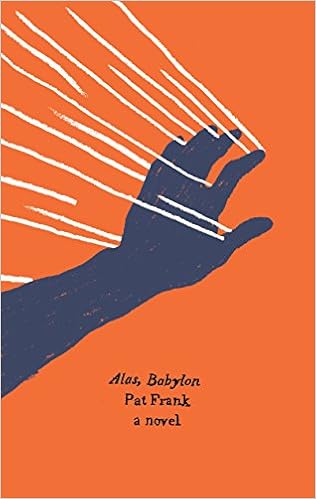
It's Pat Frank's Alas Babylon in a Harper Perennial Olive Edition that is priced at $9.74 right now on Amazon.com.  There are cheaper alternatives both in paperback and digital, but this is the edition that I found at Dollar Tree this week.

Read about it on Goodreads

And yes, I got an American classic, in pristine condition with great quality white pages, for a buck.  Finding great books at Dollar Tree never gets old!


November 13, 2017

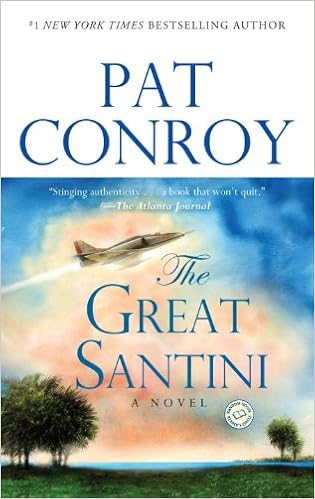
Dollar Tree Book of the Week: The Great Santini

This is my second Dollar Tree Book of the Week (see my earlier post for details).  I'm still reeling that I found something written by Pat Conroy at the DT.  What a find!  Pat Conroy is one of my favorite writers. 

Here's what I brought home -- The Great Santini by Pat Conroy, in paperback:


Maybe you recognize it from the movie version.  This 1976 novel was made into a movie with Robert Duvall in the title role, 1979's "The Great Santini."  It also starred Michael O'Keefe and Blythe Danner -- but Duvall really made that film IMHO. 

It was a good movie.  Critics loved it (94% at Rotten Tomatoes), but for me the book was so much better.  Maybe it was because I knew before I started reading it long ago that it was based on Pat Conroy's difficult childhood and that Santini, in many ways, was his abusive dad

And I got this paperback, crisp and clean, for a buck at the Dollar Tree.  What a treasure!!!!!


November 3, 2017

Dollar Tree Book of the Week: The Man Who Was Thursday

I know there are arguments against buying new books cheap (remainders). The big one:  the author will not be paid anything from the sale. 

So when I see a new book at a low price, it gives me pause.  Still, when I see a treasure at the Dollar Tree, which happens more and more often these days, I grab it up.

It's an amazing thing, to find great books for a buck -- and with the bargain, there's this feeling that I'm saving them somehow.  How can they tossed aside like this?  They need love. 

So I buy them.  And I'm buying more and more. 

In fact, so many wonderful books are showing up at my local Dollar Tree, I thought I'd start sharing them with you.

Maybe you, like me, Dear Reader will feel like you've discovered treasure too ....

My Dollar Tree Book of the Week

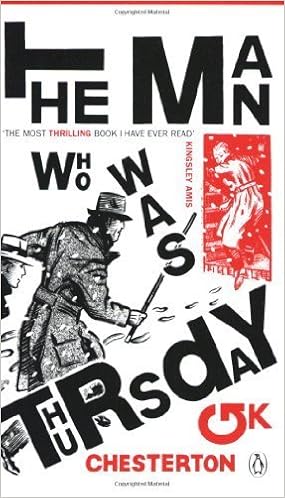
This week's Dollar Tree Book of the Week, The Man Who Was Thursday by G.K. Chesterton, published by Penguin Classics:


Look carefully, and you'll see a quote from Kingsley Amis on the cover, "The most thrilling book I have ever read."

For more on the book, check out Wikipedia, Goodreads, or the 2016 movie.

And, yes, I know it's in the public domain over at Gutenberg.  Doesn't take away from the excitement of finding this book on a DT shelf.  


December 1, 2011

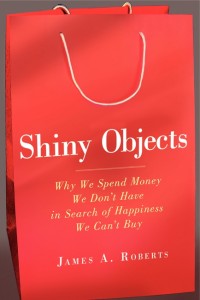
Book Review: Shiny Objects by James A. Roberts

There are those that will shelve Jim Roberts' new book Shiny Objects next to Levitt and Dubner's Freakonomics or Malcolm Gladwell's Tipping Point, and they wouldn't be wrong -- Roberts is also contributing to a growing number of books being published these days that are looking around at the state of things in America and asking what the heck is going on here.

I think it's good to see these books getting published.  I like the idea that people are buying books to read and consider reevaluating where our society is today, how we got here, and where we're going.

So why bother with this one?  What Shiny Objects brings to the table is something that seems almost like a whistleblower at work: Roberts, as a marketing expert (and professor of consumer behavior at Baylor University), brings a marketing perspective to the table.

The promise of the book's subtitle: to explain "why we spend money we don't have in search of happiness we can't buy."  Roberts does this in a series of chapters that range from consideration of the Christian Megachurches (e.g., Joel Osteen's Lakewood) to the impact of our increasingly cashless society (i.e., using credit or debit cards) and psychological discussions of self-worth and self-control.

It's a fascinating read, and you'll learn a lot here.  I don't know that we'll all learn the same thing, though.

Dr. Roberts covers a lot of territory and asks a lot of hard questions: why are we so materialistic? What amount of  responsibility do home owners have to bear for the housing crisis (as opposed to big banks, mortgage servicers, or slippery appraisers)?  Things like that.

His book has lots of quizzes, fun ones too, and I always consider it as a sign of excellence when a problem is not only identified but a solution (or two) are offered.  Roberts does this.  Roberts guides the reader into contemplating personal goals and implementing change.

For this reason alone, this book is worth your time and I recommend that you read it.  

However, I don't know that consumer behavior alone is sufficient to explain what has happened to America today.  We need to read and understand what Professor Roberts provides us in Shiny Objects, but it's not the whole answer here.

Recognizing the irony of participating in his Word of Mouth marketing campaign in providing this review on a simplicity blog (I did get the book for free, see my earlier post), I don't know that marketing alone gives us the entire answer.

Reminds me of the old poem, one of my favorites, by John Godfrey Saxe about The Blind Men and the Elephant.  Roberts gives us important information here, if we as a country are to change and recover; however, while Shiny Objects reads as if it alone can provide all the change that each of us needs, I don't think this is possible.

As a Christian, I would suggest that only the Holy Bible can do that job.  That's one book too few people are pondering today.
.

November 7, 2011

Blog Tour for Baylor Prof Jim Roberts New Book, Shiny Objects

I was recently invited to join a blog tour for a new book that has just been published by HarperOne this fall entitled Shiny Objects: Why We Spend Money We Don’t Have in Search of Happiness We Can’t Buy.  
Written by James A. Roberts, professor of marketing at Baylor University (which is about three hours due north from me on Interstate 35, up in Waco, Texas), it sounds like a great read from someone who has been studying consumerism and consumer behavior for awhile now.  (Check out his online bio here.)

I agreed to read and review the book because I liked the idea of learning what a noted academic with a reputation for studying the "dark side" of American consumerism / marketing had found.  Will Dr. Roberts have anything nice to say about voluntary simplicity?  Will he have any interesting facts and figures about all that ridiculous excess we see everyday (yes, Kim Kardashian was in the news again).

My review will be posted here on December 1, 2011.  It's part of the November 2011 TLC Blog Tour. 

Meanwhile, Dr. Roberts has a blog too, if you're interested ....


October 2, 2011

Amazon's Top 100 Free EBooks - There are Some Great Bargains Here

You don't have to own a Kindle to read an electronic book: you can download the free Kindle software and read the books on your phone or computer (which I prefer at times, actually).  This is great news for those living simple or frugal lives because ebooks cost less than paper books, hardback or softback: however, it's even better when the book is free.

Over at Amazon, you can check out free ebooks that have been vetted by readers already, in case you are worried about "free ebook" translating into, well, "horrible."  Go here and surf through the top 100 in sales at any given time: Amazon Best Sellers: Best Kindle eBooks

Look through the list and you'll find cookbooks -- like Stonybrook's Dinners Made Easy  and Circle of Friends' 25 Burger Recipes along with classics, like The Adventures of Sherlock Holmes and Pride and Prejudice as well as some great reads that don't cost you a dime. 

Heck, you can get the English Standard Version of the Holy Bible for free (it's no 14 on the top 100 today).  That's amazing.  Especially when you consider that it's searchable once you download it.  Wow, that's great when you're studying.

The free books at Amazon bring new author discoveries, as well.  For example, it was through freebies at Amazon that I learned of Chickens, Mules and Two Old Fools by Victoria Twead (a hilarious true story of a couple expatriating from England to Spain).   It's a great book: charming, funny -- and I'm excited to read Twead's new book once it's released, giving another blow by blow account of her adventures: this time, about the year that she and her husband spent teaching in Bahrain and got themselves into predicaments like sandstorms and house arrest. 

Which brings up another tip:  there are authors that promote their work by temporarily placing it as a free ebook on Amazon, to generate interest.  Like Twead did.  The book that I got for free costs you money now.  So, it's a good idea to surf the Amazon Top 100 Free periodically, to see what gems you may find there. 

Free books on Kindle: a great deal any time, but especially these days.  I think you'll like what you find, Dear Reader.   


September 8, 2011

William J. Dawson's The Quest for a Simple Life is a Free Read

Right now, you can get a free copy of William J. Dawson's The Quest for a Simple Life as an e-book over at Amazon.com -- I took advantage of this freebie, and I enjoyed his story.  It's also available online for free to read on your screen at Project Gutenberg

This isn't a new book.

William J. Dawson wrote this book long ago; it was originally published in 1907, and some of the language as well as his attitudes may seem well, ... dated.  (Feminists, take note.)

However, it's a small book and an interesting read, the language alone is entrancing (sometimes, Dawson can be a real hoot) -- and it's a nice thing to think about:  back in London, over a hundred years ago, human beings were pondering how to make life simpler. 

Well, I guess people like Thoreau were too, come to think about it. 

Okay, this isn't Walden but it's a good read nevertheless.  I liked it, thought I'd share it with you, Dear Reader.

February 28, 2011

Book to Read: The 100 Thing Challenge by Dave Bruno

There are more and more books becoming available that deal with aspects of simplifying one's life, and here's one that is worth your time to read:  The 100 Thing Challenge: How I Got Rid of Almost Everything, Remade My Life, and Regained My Soul by Dave Bruno - less than ten bucks as a paperback or via Kindle, or borrow it for free, like I did, from your local library. 

Here's how the publisher describes it:

In 2008, average American family man Dave Bruno decided to unhook himself from the intravenous drip of consumerism that fueled his life by winnowing all his personal possessions down to just 100 things. Little did he realize that he would be igniting a grassroots movement—soon after Dave embarked on his journey, media around the world took notice and others started to follow his lead.


A cause for pause, The 100 Thing Challenge is a response to the culture of materialism in America, one that has filled our lives with the constant and unsatisfactory desire for "more." Dave Bruno offers compelling anecdotes and practical advice to help readers live more meaningfully, simply by casting off the unnecessary "stuff" that clutters their lives. The 100 Thing Challenge is a golden opportunity to experience the positive changes that occur as you defiantly hop off the treadmill of consumerism.

Here's Why I Recommend This Book: 

If you want to simplify, there are lots of books out there with tips and tricks to get there - but following one man's personal experience really brings the message home.  Dave Bruno takes you through his process of changing his lifestyle and in doing so, challenges you to do the same.

As someone who's been living a simple life for several years now, more power to him.  And to you.

June 8, 2010

Free: The Future of a Radical Price - Freebies Are as Good for Business as for the Consumer According to Chris Anderson

Free is the best price, right? At least when you're buying. If you're running a business, then giving away products or services for free spells doom, right? Not necessarily. 

Why Giving Away Stuff is Good for Business

In Free: The Future of a Radical Price, author Chris Anderson posits the argument that in today's marketplace, the savvy thing to do is figure out how to combine free things -- sometimes known in other circles as GIFTS -- with products or services that are being sold.

And Chris Anderson doesn't just pontificate about this: instead, he provides lots of examples on how this is working. And by working, I mean helping businesses grow and expand in the current tight economic times. 

(Yes, this does explain why I got that free $5 gift card from Walmart a couple of months back.)

Free: The Future of a Radical Price includes real life stories of innovative marketing techniques like:
  1. cross-subsidies, where a cable company gives away a DVR to those who buy its cable service; and  
  2. freemiums, where a company offers a basic service for free and then sells its better (or premium) products at a fee. Think QuickBook's SimpleStart, its free version of its bookkeeping software with assorted premium versions. QuickBooks is my example, there are so many freemiums out there I'm sure you can think - or use - some of them right now.
 The Central Question: Lots of people are making money charging nothing.  How can this be?

Free: The Future of a Radical Price provides a history of pricing in America and elsewhere, as well as the psychological background on how prices impact our thinking.  Pricing impacts a consumer in many ways.

For example, in today's market, there are many under the age of 30 with money to spend that aren't going to pay for a product -- particularly information -- when they know that, given enough time and with some effort, they can find it free on the web.   For many other buyers, the idea that a product or service is being offered at $0.00 automatically gives that product or service certain characteristics that it would not have if it were priced at anything other than zero.

What Does This Mean for You and Me?

With rapidly expanding technology and almost unlimited access to the Internet (in more and more instances, access for the web is free), the idea of offering freebies in order to build a customer base is proving to be a valid and vital component to businesses in almost every industry out there. 

Obviously, getting a freebie from a business that's trying to sell you something is a good thing to a provider.  I was happy to get my Gift Card from WalMart.  It pleased me.  It made me feel appreciated in some way.  I saw it as a gift.  A little treat.  I liked WalMart a little better because of it. 

Free, a Price of Zero, seems to be a no-brainer for the consumer.  However, the key to Chris Anderson's work is pointing out how this is also a good thing for the provider. 

Have I shopped more at WalMart as a result of the gift card?  Maybe so.  However, I have not jumped the bar at QuickBooks to buy an upgrade of their bookkeeping software after trying out their free edition of SimpleStart.

Which may give credence to the critics of Chris Anderson's freebie idea, including Malcolm Gladwell (read Gladwell's review of the book in the New Yorker - for free) and James Ledbetter (read Ledbetter's take on things at the Slate blog "The Big Money" - also for free). 

Free Audio Version of Free: The Future of a Radical Price

Yes: the unabridged audio version of Free: The Future of a Radical Price is FREE.   For awhile, it was being offered for free on Kindle, but that window of opportunity has closed. 

Apparently, Chris Anderson practices what he preaches.

April 11, 2010

Simplifying Means Changing Your Life: Read Battlefield of the Mind by Joyce Meyer

Simplying life means changing your lifestyle.  Changing the way you live isn't done in a day, and it isn't done successfully without some major internal alterations.

You have to change your attitude.  You have to change what you value.  You have to change the way you think.

For me, that means reading Joyce Meyer's Battlefield of the Mind and then re-reading it periodically.  You can even buy it as an ebook these days (Barnes & Nobles offers this version for $8.99; the paperback is a couple of dollars more, new.)

Yes, this is a Christian book.  Essentially, Joyce Meyer is telling you that the battle for your life is between your ears.  Lessons are provided, founded in Scripture, that teach you how to change the way that you think, to recognize and tear down strongholds in your thinking, to know what thoughts and thought patterns the devil uses to thwart you, and first and foremost, this book teaches you to start thinking about what you're thinking about.  To watch what and how you're thinking.

Using the 40 Years in the Wilderness, Battlefield of the Mind identifies "wilderness mentalities" that can be wrong ways of thinking - and instructs you on how to win the battle of getting those ways of thinking out of your head.

If you're ready for change, then you're ready for the fight.  Go buy Battlefield today.  Get a used copy to save money, but this isn't a book to check out from the library.  You'll want to have this as a life tool, something to take notes in -- something to go back and re-read every so often. 

It's that helpful, it's that good.

January 17, 2010

Sunday Inspiration for Simple Living 2 - Gift from the Sea by Anne Morrow Lindbergh


Many, many years ago a friend gave me a pretty gift-book copy of Anne Morrow Lindbergh's Gift from the Sea., At that time in my life, I was more fascinated with the author and her history as the wife of Charles Lindbergh and the mother of the baby kidnapped and killed in what still may be the most famous kidnapping case in American history.  Surely you've heard of the Lindbergh Baby Kidnapping, still refered to as "the Crime of the Century"? 

Anne Morrow Lindbergh - aviatrix, author, wife of Charles Lindbergh

I looked to Anne Morrow Lindbergh as someone to admire, a role model of sorts.  Back then, perhaps I needed to find admirable, courageous people for the lessons their biographies could teach me.  I was looking for my path. 

Today, I'm older, hopefully wiser.  I've found my path and I'm walking on it.  Now, I'm more interested in the words that Anne Morrow wrote in her books than in the biographies describing her eventful life. 

Gift From the Sea is wonderful.  Physically, it's a little book which makes it all the more the masterpiece, considering the wallop that it packs.

January 5, 2010

I Love My Public Library


I love books.  I love to read.  I love to write.  So, maybe I'm a bit biased in my perspective of my local public library.  Okay, fine.  I admit it.  I am totally, totally prejudiced about my library.  Deal with it, dear reader. 

I love the San Antonio Public Libary System, particularly the Central Library downtown (nicknamed "the Red Enchilada" because its facade is painted the exact hue of red enchilada sauce).  I've included a photo of it here - those big red concrete balls never move, they're perpetually cascading down that cement wall. There's a lot of art around the place.

You know, thinking about it, love isn't a big enough word.  I ADORE the Big Red Library we have here.  Why?

It's Convenient.

When I drive down to the Central Library, I get covered parking that's free for the first hour.  I never have far to walk to reach the front door (which is great when I'm lugging a load into the return desk). 

Holds are found on the first floor, near the exit.  Go there, and search the stacks for your last name and voila! Anything that you requested online be pulled for you sits there. Waiting for you.  Nice.

January 3, 2010

Free Online Daily Devotionals Delivered Every Morning to Your Inbox Instead of Buying the Same Thing at the Bookstore


If you want to spend some cash on a collection of devotionals, the market is ready to serve you. Over at Amazon, for example, you can get the following:

Morning &Evening by Charles Spurgeon (2003 Hardback edition, updated) $14.95

Day by Day by Charles Swindoll (2005 Paperback edition) $10.19

Today God is First by Os Hillman (2002 Paperback edition) $13.99

You can get these same devotionals for free online, which is such a gift from each of these authors (although I believe Spurgeon's work may be in the public domain by now). 

Many may find the online versions to be more useful than owning the paper version, since each day's message can be automatically sent to your email inbox. You don't have to remember to pick up the book, you just have to take the time to read your mail. Just sign up for the free service at Crosswalk.Com:

Morning & Evening - online

Day by Day - online version

Today God is First - online version

Image:  From the December 1870 issue of Vanity Fair, a caricature of Charles Haddon Spurgeon, author of Morning & Evening, his only daily devotional.  Famed as a orator, Spurgeon was pastor of London's New Park Street Chapel (lka Metropolitan Tabernacle) as well as being a traveling evangelist who is said to have preached to over 10 million people during his lifetime (1834-1892). 

January 14, 2009

Simple Inspiration & Frugal Encouragement -1: Thoreau

Times are tough and lots of people are scared. Some of them will just sit and stay that way; however, others -- like you, dear reader -- may be seeking inspiration to commit to a simple life and a frugal future, or you're already committed and maybe needing a little encouragement along the way.

So, during 2009 here at Everyday Simplicity, you will find weekly posts dedicated solely to encouragement and inspiration.

Like this one, bringing you some words from Henry David Thoreau. Now, if you want to read the entirety of Walden, you can, for free. It's on the web (the copyright has long since vanished), and it's broken down into chapters so you can take it in spurts if you'd like.

Sure, you may have studied it in college as an example of transcendentalism - but Thoreau's writing really does read as a concrete, comforting example of choosing to live a simple life.

In Walden, he begins with the first two chapters giving you, the reader, concrete information on his daily activities, like how he built his sturdy little cabin all by himself; how he tried to get going to beat the sunrise; what he ate and how he kept his perishables safe from spoilage. And, while he is journaling his progress in making a home for himself out in the wild, he shares his thoughts with you -- and it's here that you will hopefully find encouragement.

From chapter 1:

...But men labor under a mistake. The better part of the man is soon plowed into the soil for compost. By a seeming fate, commonly called necessity, they are employed, as it says in an old book, laying up treasures which moth and rust will corrupt and thieves break through and steal. It is a fool's life, as they will find when they get to the end of it, if not before....

Actually, the laboring man has not leisure for a true integrity day by day; he cannot afford to sustain the manliest relations to men; his labor would be depreciated in the market. He has no time to be anything but a machine. How can he remember well his ignorance- which his growth requires - who has so often to use his knowledge? We should feed and clothe him gratuitously sometimes, and recruit him with our cordials, before we judge of him. The finest qualities of our nature, like the bloom on fruits, can be preserved only by the most delicate handling. Yet we do not treat ourselves nor one another thus tenderly....

Public opinion is a weak tyrant compared with our own private opinion. What a man thinks of himself, that it is which determines, or rather indicates, his fate....

The mass of men lead lives of quiet desperation. What is called resignation is confirmed desperation. From the desperate city you go into the desperate country, and have to console yourself with the bravery of minks and muskrats. A stereotyped but unconscious despair is concealed even under what are called the games and amusements of mankind. There is no play in them, for this comes after work. But it is a characteristic of wisdom not to do desperate things. ...

When we consider what, to use the words of the catechism, is the chief end of man, and what are the true necessaries and means of life, it appears as if men had deliberately chosen the common mode of living because they preferred it to any other. Yet they honestly think there is no choice left. But alert and healthy natures remember that the sun rose clear. It is never too late to give up our
prejudices. No way of thinking or doing, however ancient, can be trusted without proof. ....


I don't know about you, but I love this stuff. Reading these words strengthens me, reminds me about what's important and what's not.

And, silly as it may sound, it makes me feel proud of my lifestyle choice.

Every morning, I awake to hear the boom! of the cannon over at Fort Sam Houston, awakening the soldiers at exactly 5:30 a.m. Every night, at 11 p.m., I stand outside and hear taps being played. And between those two bookends of my day, I try very hard to live a rich, peaceful, simple and rewarding life without that hamster on a wheel feeling I used to experience in my Suit and Heels past.

Living a simple (frugal) life really is just a better way to live. It's work to choose this route, and work to stay on track in this American culture we have today (I was just called "crazy" by an old friend last week at lunch) but it's so, so worth it.

Go read Thoreau. I'm really hopeful that you'll share that Attaboy feeling that I found there.

December 28, 2008

Books on Simplicity Rising in Popularity (Though They're Calling it Frugality): Here's a Reading List

Over at the Salt Lake City Tribune, they're sharing an article written by Susan Carpenter of the Los Angeles Times, "Books: Concept of frugality makes comeback - Salt Lake Tribune". And guess what? It's all about that classic simplicity tome, Your Money or Your Life: Transforming Your Relationship with Money and Achieving Financial Independence by Joe Dominguez and Vicki Robin.

Yep, the one written about 40 years ago ... although it has been revised and updated for today's market. Of course, they're confusing frugality and simplicity: leading a simple life is a lifestyle that is far from lack (which the term "frugality" might suggest). Simplify your lifestyle and enrich your life - simplicity isn't about loss, it's about gain.

If you're interested in reading more about living a simple life, here are some Simplicity books worth your time:

Finding Happiness by Christopher Jamison

100 Ways to Simplify Your Life by Joyce Meyer

Choosing Simplicity: Real People Finding Peace and Fulfillment in a Complex World by Linda Breen Pierce

Living the Simple life: A Guide to Scaling Down and Enjoying More by Elaine St. James

Voluntary Simplicity, Revised Edition: Toward a Life that is Inwardly Simple, Outwardly Rich by Duane Elgin

The Simple Living Guide by Janet Luhrs

The Complete Idiot's Guide to Simple Living

Affluenza: The All-Consuming Epidemic by John de Graaf, David Wann, Thomas H. Naylor

Self-Reliance by Ralph Waldo Emerson

Walden by Henry David Thoreau

Approval Addiction: Overcoming Your Need to Please Everyone by Joyce Meyer

For more, check out Books to Read at Everyday Simplicity.

November 30, 2008

Fr. Christopher Jamison's New Book On Simpliciity Gets Media Play By Taking On Disney as Promoting Materialism and Greed - Is He Right?

Over in England, Christopher Jamison is a Benedictine monk known as the Abbot of Worth in West Sussex, and he's a prominent figure in Catholic circles -- touted by many as the next Archbishop of Westminister. (You know, that Westminister.)

Jamison starred in a hit TV series on the BBC (The Monastery) and he's just come out with a new book that encourages people to live simply. The title? Finding Happiness.

In his book, Jamison offers advice in changing your lifestyle to one of simplicity by changing the way you think and upping your self-discipline. In fact, he argues that there are 8 thoughts that must be controlled to find happiness; they are:

anger
pride
gluttony
lust
greed
sloth or spiritual apathy
sadness
vanity.

Father Jamison isn't timid. He's boldly taken on the celebrity news media as helping people to become dissatisfied with their personal circumstances, encouraging envy. And, he's not stopped there.

Jamison is also getting a lot of news coverage for taking on Walt Disney's legacy. He argues that the current Disney conglomerate offers product that does have value (an example: Sleeping Beauty does give a lesson on good vs. evil) but Jamison decries the corporation for tying so many secondary products and services to its films - thereby encouraging the indoctrination of children into materialism and cultural greed.

For more on Jamison's position, check out the Telegraph's article, Disney accused by Catholic cleric of corrupting children's minds, and the quotes from one of his interviews in the Church Times, which includes this statement, where he is discussing Advent:

“We see Advent as a very seriously charged moment, in which we . . . refuse to behave as though the way to salvation is to spend more and to get into debt more, because that is what has got us into this trouble in the first place,” he said at the launch.

“The antidote to greed is waiting. It is not never shop,but shop less; not stand still, but go slower; but that is not what the politicians are going to tell us. The Chancellor is going to say ‘Spend like before.’ But that is what has got us into trouble in the first place.

“The economy is going through a readjustment, whether we like it or not. If we behave like we have in the last ten years, then we will just see another crisis. We have to work for an economy with a more solid foundation in order to skip the boom and bust. But the politicians have not done that.”

November 19, 2008

Even Joyce Meyer is Simplifying Her Life: She Has a New Tips Books Out

100 Ways to Simplify Your Life is Joyce Meyer's latest book release, and here's the plug from Amazon.com:
"Joyce Meyer is one busy lady. Apart from the normal demands of life, she teaches daily on TV and radio, writes books, holds conferences in dozens of cities every year and ministers around the world...and she runs JoyceMeyerMinistries. So she's had to learn how to make the most of every minute of the day! In 100 Ways to Simplify Your Life, Joyce shares the most effective secrets she's learned over the years for making the most of each minute of the day. In less than two pages per entry, Joyce gives us eminently 'doable' tips that are clearcut and ...well, SIMPLE. But they can change your whole outlook, not to mention your schedule."
Tips include (1) do one thing at a time; (2) be satisfied with what you have; and (3) keep God first. Each tip includes a reference to scripture, a quotation, and a brief teaching discussion by Joyce herself.

Who's Joyce Meyer? Here's her Wikipedia bio and here's the link to her ministry website.

April 2, 2008

What is Simplifying? Should You Do It?

Today’s news is filled with scary stories about the cratering sub-prime lending market, the dollar’s decline, and the plunging Dow. This has got a lot of people pondering ways to cut back on their spending, getting ready for a severe recession that seems more and more inevitable.

Tightening your money belt is a good thing, it’s a smart strategy. However, it’s very different from simplifying your life. Cutting back is painful; simplifying is freeing and fun. Maybe now more than ever, it’s time to think about simplicity.

Simplifying isn’t a new concept: the Shakers were propounding the benefits of living a simple life over 150 years ago. Janet Luhrs’ book, The Simple Living Guide, has had steady sales since its debut in 1998, and this April will mark the 14th anniversary of Vicki Robin’s famous speech to the United Nations, “A Declaration of Independence from Overconsumption.”

What is simplifying? It’s going against the materialistic mainstream and proactively living a life that you have consciously defined for yourself. There are many reasons for simplifying, and there are many different types of simplifiers.

For some, simplifying life means reducing stress for health reasons, for others it’s a social justice or anti-consumerism issue. Simplifiers can be as straight-forward as families transforming into one-income households so their kids can have a full-time parent at home, as well as someone deciding to buy only organic or locally-grown produce. They can also be as multifaceted as environmental activists, seeking to minimize their consumption of fossil fuels by living off the grid along with those involved in The Compact, where members have committed to buy absolutely nothing new for one full year.

Ed Begley, Jr., of the cable television show “Living With Ed,” is a simplifier. So is Julia Roberts, who took time off from her career to stay at home with her young children.

If the news of an impending recession has you pondering your way of life, and wondering if perhaps there is a better way, then you may be interested in simplifying. Should you choose to do so, know that it has tremendous benefits: there is a surprising sense of freedom with each step you take, and there is suddenly more time to do the things you care about. However, it’s not for the faint-hearted: you’ll have discouraging friends and family who will not understand this change in attitude, and you’ll have moments of being overwhelmed at the undertaking.

For those who have taken steps to simplifying their lives, though, it’s been worth all their efforts. Life truly is better without the call of the mall.

If you’re interested in learning more, check out:

1. In Print

Choosing Simplicity: Real People Finding Peace and Fulfillment in a Complex World by Linda Breen Pierce. Stories of those who have downsized their lives, relates their experiences and whether or not they regret the change.

Your Money or Your Life: Transforming Your Relationship with Money and Achieving Financial Independence by Joe R. Dominguez and Vicki Robin. Financial guide, a landmark in the Simplicity movement.

Living the Simple Life : A Guide to Scaling Down and Enjoying More
by Elaine St. James. Good, practical tips (cancel the newspaper subscription, eat at home).

Voluntary Simplicity, Revised Edition: Toward a Life That is Inwardly Simple, Outwardly Rich by Duane Elgin. History of the movement, discussion of spiritual motivations behind downsizing.

The Simple Living Guide by Janet Luhrs. Must-read; describes all variety of lifestyles within the "voluntary simplicity" world.


2. Online

Everyday Simplicity (http://everydaysimplicity.blogspot.com)
The Simple Living Network (http://www.simpleliving.net/main)
Simple Living America (http://simplelivingamerica.blogspot.com)
February 9, 2007

Book Report 1 - The Great American Detox Diet

You've seen Alex Jamieson if you've watched SuperSizeMe - she appears throughout the documentary, providing her eyewitness account of boyfriend Morgan Spurlock's declining health as well as her mounting concern for his well-being. Immediately after Spurlock stopped his 30 days of solely McDonald's food, Jamieson took over with an 8-week plan to return Spurlock to health. So many requests came in, asking Jamieson for details, that she wrote The Great American Detox Diet.

It's a good read, easy to follow, and filled with information encompassing much more than a food plan. Details about the FDA, various food industries, and the like are included -- important things to know.

As for the basic detox, it's pretty straightforward: no sugar, no refined carbs, no caffiene, no alcohol, no dairy, no meat. Lots of water, whole grains, berries, beans, nuts and seeds. Since Spurlock's liver was impacted, she included herbs and greens that help the liver (escarole, broccoli rabe, etc.).

Jamieson gives you the ability to personalize your plan: kidneys a concern? She tells you what to eat, and what to avoid, for maximizing your kidneys' health. Stressing out? She gives suggestions on how to solve that problem.

The book itself sets up an 8-week plan to detox, and provides lots of recipes as well as a week of sample menus. Pantry help is given, too.

I liked the book. I also recognize the overlap in advice with that given in The Maker's Diet, among others. That's okay with me. Living food, lots of water, exercise, and breathing right: these are all things that go hand in hand with simplifying life and living in an abundant way.

Personally, the more that I adopt these principles, the better. I feel better, and I'm happier. It still amazes me how the food I eat impacts my attitude, but it does. Lots of processed food, I'm tired, depressed, blah at best. Lots of living food, I'm energetic, excited, and having fun.

Just like Morgan Spurlock describes in the movie, and Jamieson discusses in her book. It's worth your time to read the Great American Detox Diet.

June 2, 2006

333,000 Free Books That You'd Actually Want to Have

Get ready. For thirty days next month (July 4 - August 4, 2006), you are welcome to download as many of the (approx) 333,000 offered at the World EBook Fair as you'd like. For free. And, mark your calendar: next year, the ante ups to 500,000 available; in 2008, it's 750,000; and the number hits a MILLION in 2008.

What kinds of books will be offered? Things you'd never buy at a garage sale? Nope. Good stuff - great stuff is available.

During the last 30 days the top 100 ebooks downloaded from Project Gutenberg included:
Pride & Prejudice by Jane Austen;
The Adventures of Sherlock Holmes by Sir Arthur Conan Doyle;
Secret Adversary by Agatha Christie;
Roget's Theasaurus; and
Hand Shadows to Be Thrown Upon A Wall by Henry Bursill.
The World EBook Fair will, of course, offer much more than the standard collection from which these works were downloaded.

To learn more, and to download, visit Project Gutenberg for details or just check out the World EBook Library.
Related Posts Plugin for WordPress, Blogger...