Showing posts with label Economy. Show all posts

November 25, 2016

How Many People Are Living in Their Cars? Simple Living in 2016

.
.

It's been a long, long time since I chose to live a simple life -- I started this blog as a part of that process, back in January 2006.  It's amazing to realize this blog is almost 11 years old.

Your life is your life.  You only get one.  YOLO, right?  With your free will, you make choices that have consequences.  Not choosing is still making a choice.

So I chose to live a voluntary simplicity lifestyle.  What that means, to me at least, is all over this blog.

Choosing a Simple Lifestyle


I'm proud I had the courage to choose the path less traveled way back when. As a lawyer, choosing to live a life of simplicity back in the mid-2000's was not understood by lots of folk.  To many, I was nuts.

I don't know how much that's changed or how much I've just stopped worrying about the approval of others.


The Economy Around Me


For awhile, I'd post here about economic things that concerned me.  Over there in the sidebar, you can see categories for "2008 Economic Crisis," and "2011 Economic Crisis," for instance.

Then I stopped blogging about it.  Truth be told, I got busy with other things and just didn't post very much.

But this fall, I decided maybe I should blog again.  Blog some.  Blog more often.  And so I began, even though participating in National Novel Writing Month sideswiped some of that blogging schedule in the past few weeks.

Which is why I'm publishing this post today.

What the Heck?  


All this meandering to get to here.  My point.

What the heck is going on here?  I know Preppers.  Heck, there are some of my Fancy Friends who think I'm a Prepper.  They worry because I don't know the trends and don't like credit cards.

Then the Preppers worry that I'm not doing what I need to do in order to survive the impending economic explosion.  I'm not working each week on implementing a Survival Plan.  I don't know how to can food.

But back when I began on this road, I don't think there were that many folk living in their cars.  And I mean cars or vans, not RVs or Travel Trailers.  That's the subject of another post for a different day.

I have used YouTube quite a bit this past couple of months to research my NaNoWriMo thriller, and in the midst of all that video surfing, I have discovered a great many YouTubers chronicling their lives as they live in their vehicles.

Go look at the search results yourself in YouTube for "living in car." 

It's amazing.  I'm seeing young women, brave and happy and apparently well-adjusted, choosing to live in their sedans or small SUVs because they've decided it's a great idea.  

Some are doing this to pay off student loan debt ASAP.  Others have their own reasons.

Living in Your Car as a Simple Living Lifestyle Choice


This choice, just like any version of simple living, isn't a One Size Fits All.  Each story is unique, as is how each person approaches simplicity -- or minimalism, the term that's arisen since I started this blog.

Thing is: when I began looking around online, it's not all fun and games.  There are people living in their cars because they have no option.  They're more the homeless stereotype of the "van down by the river" and they aren't so happy or excited.

So, it's something I'm thinking about right now.  Times are changing.

How bad is our economy really? I don't know.  I'm thinking about this.  Back in May 2010 I wrote a post after reading a London Times article on the 'Great Depression of 2010."  I am thinking about that frog in the pot right now.

One thing I do know.  When I started simplifying, it was far from a trend to have folk living in their cars like they do today.

The continuum on simplicity existed but van-dwelling wasn't really on the charts back then.  It is now.  That is telling me something, I think.

See, "Living Out of a Van Is The New American Dream," written by David Jagneaux and published in Vice on February 5, 2016.

Here's a YouTuber video example for you:


Will all this pondering cause me to make changes in my lifestyle?  Will I go more prepper now?  Will I decide to get a vehicle that if necessary, I can live in comfortably?

What about expatriating?  It's these kinds of thoughts that lead me to prayer and the Bible and get me in the kitchen cooking up some sort of dish filled with melted cheese.



September 30, 2013

The Shopper’s Thrill of the Great Bargain Find: Dollar Tree and Great Books (For a Buck)


 I’ve been living the Voluntary Simplicity lifestyle for many years now, but that doesn’t mean that I’ve lost that thrill of stumbling upon a great bargain while shopping. It’s just that the store names have changed, and the amount that I’m willing to pay is lots (LOTS) less now.

That zing in your heart strings, or purse strings, when you find something great for a low price? It’s still there.

Like it was for me last week.

Go back with me, Dear Reader, as I was pushing my little green shopping cart through the aisles of my local Dollar Tree, which in my opinion is the nicest dollar store out there. (At least in my neck of the woods, San Antonio.) Sure, there’s the need to eagle eye the products here, as in any bargain paradise (be it thrift store, flea market, garage sale, or WalMart) - you have to discern quality from crud.

Dollar Tree is My Favorite Dollar Store -- I Shop Dollar Tree Once a Month for Bargains

There are quality items to be found at Dollar Tree, and the reason that I prefer this chain to the others is two-fold: if I pick it up, I know it’s $1.00 or less (unlike some other “dollar” stores) and there’s more quality stuff at the Dollar Tree chains. At least, this has been my experience. Plus, they’re clean and their workers are friendly and helpful.

I visit Dollar Tree once a month without fail because I find great things there, like this week: 

  1. Brillo sponges (not pads), blue, with a scruffy surface on one side (package of two for a buck). 
  2. Index cards (200/$1.00)(I love using index cards for lots of things, it’s Old School, I know). 
  3. Plastic flowers for my outdoor wreathes (amazing quality, these plastic blooms - very slow to fade). 
  4. Betty Crocker kitchen stuff (got a primo pasta spoon for $1.00). 
  5. Baskets and bins (sweet, big reed basket for a buck - perfect for a gift basket). 
  6. Gift bags (this store doesn’t have the great selection I have seen in other D-Trees, but big bags for a buck is still nice). 
  7. Tape (got Scotch brand clear tape, enough to last me a year at least, two rolls for a buck). 
  8. Del Monte canned vegetables (two regular cans for a buck). 
  9. Dog toys (I don’t buy their edible offerings, but the small stuffed toys are safe and my pups love them - for the 30 minutes it takes for them to tear them apart outside in the grass.) 
  10. Books. That’s right, Dear Reader. BOOKS. 


My local Dollar Tree has some wonderful finds - and I thought I’d share with you the books I’ve bought this month at Dollar Tree: 


Is This Unfair to the Author? Geez Louise, I Hope Not 

I’m not the only one who has discovered great reads at the dollar store. Lynn Viehl writes of buying up some of her author/friend’s books upon discovering them at a dollar store in her April 2005 blog post - and she explains the reasons why finding books in a dollar store might make an author cringe.

 I love authors, I love books, I don’t want to hurt writers in any way. However, without Dollar Tree I would not have known about Richard Lupoff - nor would I read Linda Fairstein (even though I have heard of her name before).

Are these writers making money off my Dollar Tree buys? Nope; these are “remaindered remainders” as Viehl explains. Jance, Fairstein, Evanovich, Briggs, and Lupoff will make no more from their artistry and hard work on my copies than if I’d borrowed their books from the library.

However, they’ve gained a fan in me through DollarTree, and that’s got to be worth something, right? Especially when you consider that these are all series reads, where I’m going to be searching for the rest of the series? (Well, except for Plum. I’ve got almost every Stephanie Plum already.)

Plus, I like to think it’s better to scoop up these great finds at the Dollar Tree than to leave them there. I mean, the only thing worse than finding these books at the dollar store would be to discover that no one bought them there, right?

June 6, 2012

Lifestyle Success: What Does That Mean to You?

Sheep waiting for a train.  Look familiar?

I ran across the phrase "lifestyle success" somewhere recently.  Can't remember where. Twitter?  I googled it of course. (Is that a recognized verb yet?  You know it will be if it's not already.)

Lots of different things popped up in the search results but no one theme.  There's not a movement towards "lifestyle success" like there is towards "voluntary simplicity" for example.

What I found - or to be more accurate, didn't find - gave me pause.  Why not?  Why aren't there lots of places on the web discussing lifestyle success?  Isn't that part of your decision-making?

Seems to me that in this American culture, we've all spent way too much time letting other people and other places decide for us what lifestyle success means.  It's got us in lots of trouble.

What is lifestyle success? 

What does it mean to you?  Who are your role models for successful living?  (Is it really and truly the Kardashians?)

January 13, 2012

Energy Saving Curtains – I’m Loving Mine So Far

This week, the temperatures here in San Antonio dropped from a pleasant low 70s/high 50s range to yesterday, where the high was something like 48 and the lows got into the 20s.  Which means this week was my first chance to really test out how my new Energy Saving curtains really worked.

I love them.

Not only do these things block noise, which gives me a better night’s sleep, but the heater isn’t coming on nearly as much.  I haven’t got my new utility bill yet, but I know it’s going to be less – it’s that obvious. 

There are negatives, of course.  In the bedroom, I replaced some very pretty Battenburg Lace curtains with these babies, and the new ones are not as pretty and there’s a lot less light now.  I didn’t buy full blackout curtains, but these “energy savers” do make the room lots darker. 

This can be solved by a tie-back or two, so I’m not that concerned with this issue.  Truth be told, at night the thicker curtains make the room much cozier for sleeping than the lace curtains did.  I’m losing the beauty of the sunlight coming through the lace to get this, but right now I’m okay with it. 

I’ll keep you posted on what the utility bill does this month and next month, too.  I’ve been these curtains in most of the house now, so there should be a big difference. 

November 7, 2011

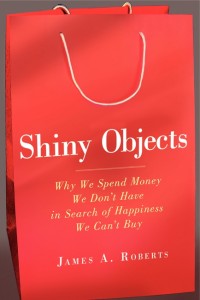
Blog Tour for Baylor Prof Jim Roberts New Book, Shiny Objects

I was recently invited to join a blog tour for a new book that has just been published by HarperOne this fall entitled Shiny Objects: Why We Spend Money We Don’t Have in Search of Happiness We Can’t Buy.  
Written by James A. Roberts, professor of marketing at Baylor University (which is about three hours due north from me on Interstate 35, up in Waco, Texas), it sounds like a great read from someone who has been studying consumerism and consumer behavior for awhile now.  (Check out his online bio here.)

I agreed to read and review the book because I liked the idea of learning what a noted academic with a reputation for studying the "dark side" of American consumerism / marketing had found.  Will Dr. Roberts have anything nice to say about voluntary simplicity?  Will he have any interesting facts and figures about all that ridiculous excess we see everyday (yes, Kim Kardashian was in the news again).

My review will be posted here on December 1, 2011.  It's part of the November 2011 TLC Blog Tour. 

Meanwhile, Dr. Roberts has a blog too, if you're interested ....


October 31, 2011

Angel Food Ministries Is No More - And There's No Ready Replacement

Angel Food Ministries did a great service for a lot of people all over the country, and it's sad to learn that Angel Food has stopped operations.  They provided great, restaurant-quality food to folk at a very reasonable price, no questions asked. 

I personally saw Angel Food make a difference in the holiday meals of several families when I worked with abused and neglected kids at the local CPS Children's Court.  Single moms were particularly happy with the chicken nuggets, as I recall -- the kids loved them.  Loved them.  And, another great thing about Angel Food is that distribution routed all around town, via local churches and a network of volunteers, so it was never that difficult for the moms to get to the monthly pickup with their baskets and Styrofoam coolers. 

There was a pride thing, too.  Angel Food didn't ask for income information or stuff like that -- if you wanted to participate, then you were welcome to do so.  For example, I knew of several school teachers that took advantage of the Angel Food packages as times got tight and tighter, especially their holiday packages. 

I swayed more than one CPS teen mom to try Angel Food after sharing that they wouldn't be asked money questions and that they might be in line next to a teacher.  No, not all these CPS parents are strung-out druggies: some are just young, uneducated, alone, and overwhelmed, and with some pride to protect.  Angel Food was top of the line stuff, at about half the price of retail. 

So, today, I'm sad to hear that Angel Food is no more and I'm hopeful that something just like it will pop up to serve the community; Angel Food wasn't the same as the food bank,  it would have been much more difficult to get those teen moms to go to the food bank than to the local church for Angel Food. 

There's talk of another organization filling this gap:  One Harvest Food Ministeries.  They are planning on starting food distribution akin to Angel Food next month (November 19th) and hope to go national within the year. 

Let's hope and pray that One Harvest Food has great success. 


October 6, 2011

WSJ Writes of "Forever Frugal" Trend - But Misses the Point That Many Choose Frugal as a Better Lifestyle

In the Wall Street Journal today, there's an article written by Ann Zimmerman entitled, "Frontier of Frugality: Retailers Face Reality That Many People Can't Trade Back Up," and it's filled with information from the American retailers' perspective.  WalMart is experiencing lots of shopping tied to when folk get their paychecks; retailers are seeing lots of shopping with coupons; people aren't jumping to buy premium labels like they used to do.

I find it interesting that there's something missing here (though they tip their hat to this at the end of the piece):  the reality that living simply is a lifestyle choice for many.  For others that have had to change their lifestyles because of unemployment, illness, or just fear that their stock prices are going to crater, it can come as a very nice surprise that living differently is not so bad.  There are people in this country who were forced into frugality by a sudden change in circumstances and are sold on not going back to their old ways, even when they can do so. 

Couponing feels good for those who do it.  It's a rush to save a buck - today on Coupon Mom's email, for example, I saw free Colgate toothpaste and free Cover Girl cosmetics at Target; 6 freebies worth $41 at RiteAid; and 5 freebies worth $52 at Walgreens (she's got lots more deals if you're interested). 

Heck, I want my free Colgate toothpaste at Target -- and it's not because I'm scrimping pennies here, it's because it's FREE.  It's like a little gift, a little treat.  To Reba, From Target.  I like this. 

I like free.  You probably do, too. 

I also like the idea of saving money on my food budget.  But I'm not doing this because of the money.  Long ago, I would spend a shocking amount of my disposable income on fast food or restaurant fare.  It was not good for my pocketbook.  More importantly, it was not good for my BODY.  Now, I shop with a list and a menu planned out -- and I save lots of dough.  Bigger deal: I know what I'm eating.  I'm eating organic, I'm not cooking in aluminum, and I'm washing my lettuce. 

If I do this near a payday, are retailers thinking that I'm cutting back because of the economy?  Maybe.  And, sure, some folk are. Times are tough, and there are lots of people in financial distress in this country.

I don't know that they are all setting around, depressed that they can't buy retail, though.  Which is part of the tone that I read in the retailers' discussion. 

I have changed the way that I spend money because I have found a higher quality of life by doing so.  I am not alone.  My grocery bill is less, not because I'm money-motivated, but because I'm eating fresh food, I'm cooking at home, and I'm not falling prey to advertising siren songs. 


Does this make me "forever frugal"?  Yes, I think so.  Does this mean that maybe Americans are sick and tired of being endoctrinated into materialism?  We'll see. 


March 30, 2011

Food Packaging Gets Tricky: Smaller Packaging for the Same Price

Food packages
Wikimedia Commons
Public Domain
A couple of weeks ago, I roamed around my local grocery with a list of items that I had purchased in January 2008 and compared what the prices were today, in 2011.

You can read that comparison for yourself here.

At the time, I thought "tricky, tricky" when I discovered the can of diced tomatoes and the box of pasta were both packaged in smaller amounts.  Not a huge difference, but it would add up fast enough if you were the manufacturer/supplier. 

Today, while surfing the web, I discovered that I'm not the only one wondering about this little trick.  At the New York Times, Stephanie Clifford and Catherine Rampell have written an article published today, "Food Inflation Kept Hidden in Tinier Bags," where they've investigated this national trend -- something that isn't new, they've been doing this for decades -- and its current guises:  companies are going green, offering more portability, etc.

No company wants to flat out admit that they're trying to keep that price on the can or box or bag from rising, and they'll just change that container before they'll up the price -- because maybe you'll choose not to buy their goods if you see that number rise.

Maybe you will, maybe you won't.  Truth is, food is food - and if you're needing two cups of tomato sauce for your recipe, you'll buy accordingly.  Some folk will be fooled by this trick.  Savvy shoppers won't.

Here's the reality.  The dollar is worth less, and things are costing more.  We're impacted by things like the rising cost of oil much more than in our gas tank.  (See my earlier post listing lots of products made by petroleum to get an idea.)

Times are tough, and getting tougher.  Which just makes living a life of voluntary simplicity that much smarter, IMHO. The fun, peace, quality of life -- that's just an added bonus or three ....

FYI:  I did another price comparison in August 2017.  You can read about it here.  

March 9, 2011

Grocery Prices Going Up: What I Found Out Here in San Antonio About Food Costs

In January 2008, I wrote about how much I paid for certain items here in San Antonio (you can read that post here).

This past weekend, three years and one month later, I went back to the same store and priced the same list of items. Here is what I found in what admittedly is based only on my curiosity and isn't any formal statistical analysis at all:

[Prices that rose in red; prices that fell in blue.]

1. Dole Yellow Bananas .39/lb in 2008; in 2011, .38/lb.
2. Small Limes - 5/$1.00 in 2008; in 2011, 4/$1.00
3. Store Brand Cage Free Brown Eggs - 1 Dozen $1.99 in 2008; in 2011, $4.10
4. Silk Unsweetened SoyMilk 1/2 Gallon - $2.79 in 2008; in 2011,$2.76
5. Store Brand 98% Fat Free Cream of Mushroom Soup - $0.75 in 2008; in 2011, $0.72
6. Store Brand Diced Tomatoes Canned 15 oz. - $.59 in 2008; in 2011, for a 14.50 oz., $.75
7. Regular Ground Beef Chuck 70/30 16 oz. - $2.08 in 2008; in 2011, $2.38
8. Suave Invisible Solid Powder Deodorant - $1.48 in 2008; in 2011, $1.72
9. Store Brand Frozen Green Sweet Peas 16 oz. - $0.92 in 2008; in 2011, $1.07
10. Barilla Plus MultiGrain Rotini Pasta 16 oz. box - $1.65. in 2008; in 2011, for a 14.50 oz box, $1.98

Of note: 

1.  some of the packaging had changed:  both the pasta and the tomatoes were in smaller packaging. 
2.  none of the items were on sale - either back in 2008 or this week - when I did my little survey.

October 20, 2010

Vertical Farming: Have You Heard About This Yet?

Over at The Vertical Farm, they've got some very interesting info for you.  For instance, these folk are advising that within the next 40 years, we'll be facing the basic need of feeding around 3,000,000,000 (three billion) mouths. 

We can't do it with the farmland we've got now.  Problem.  Unless we get creative and farm differently.  One solution: vertical farming. 

Which, yes, is something a lot more complicated that the Baker's Rack Vegetable Garden I tried to grow long ago on the apartment balcony -- but at least I got that footprint idea right ....

It sounds pretty darn smart - especially the recycling aspects, and the idea of safe water and safe food.

For more info, watch this:

September 20, 2010

The Changing Value of a Dollar: What a 2010 Dollar Converts to in Past Years

Okay, I was watching a rerun of the Andy Griffith Show this week, and it was the episode where Helen Crump gets a children's book published - and Andy worries about being put on the back burner what with Helen becoming a rich and famous author.  Of course it works out, Andy apologizes in the end - but not before there's some tension between him and the nice schoolteacher.  (To watch Helen the Authoress, episode 213, go here.)

What is a 1967 Dollar Worth in 2010?

Here's the thing: as I was watching the show, I got curious about the $1000 advance that Helen received for the book -- all of Mayberry was very, very impressed.  Now, today, that's not that much money.  Not that any of us would turn it aside, but it's not the stuff of "rich and famous," right?

So, I went and checked on the web and found this Inflation Converter at DollarTimes.com.  According to their site, Helen's retainer amounts to around $6500 today.  That's nicer, but still not the big fat number that the Mayberry awe was suggesting to me. 

Still, it's interesting to ponder how a dollar has changed so much in so little time, right? 

May 17, 2010

The Great Depression 2010 - Are We There Yet?

Image: "Migrant Mother" by D. Lange,
(colorized version)
Wikimedia Commons, Public Domain
In London's TimesOnline yesterday, columnist Minette Martin warned that England must prepare to live once again as it did during the years surrounding World War Two - she labels it as "austerity chic." Her column, "Waste Not, Want Not: here comes the new austerity chic," is worth the read.

Ms. Martin discusses how those of the 1930s and 1940s kept their frugal habits through the remainder of their lives, and how the realities of debt and unemployment in Great Britian today will be forcing its citizens into a new area of "austerity."  She encourages her readers to "embrace the new thrift," and how this can actually be a good thing. 

But here's the clincher:  this well-respected journalist in an internationally renowned publication actually uses the word "poor" -- which is, of course, the terror striking the hearts of so many right now. 

The Great Depression - Is It Here Already?

There's actually a website that is devoted to "The Great Depression 2010."  It describes itself as a "chronicle" of those events that mark the United States' descent into another Great Depresssion.  In 2008, experts were already discussing another Great Depression by 2011.  Heck, Wikipedia has an article entitled, "the Financial Crisis of 2007-2010," and it's pretty detailed and worth your time, if you're into the economic aspects of this thing.

However, in answer to my question, it the depression here already, I am looking not at discussions of the evil that is Goldman Sachs, or bubbles, or the impact of Japan or China or India or Mexico upon our country.

Are We Doomed to be (gasp) Poor?

Instead, I'm looking around me at what I see in my world - as I've done before.  And, I don't think we're there yet, at least in San Antonio, Texas.  Depressed, maybe, but it's not "Great" -- yet.  But I think we're gonna see it, and maybe that means within the next 6 months. 

It's bad here, don't get me wrong.  Lotsa empty store fronts and hungry people.  However, this weekend as I drove past the North Star Mall, its parking lot was still full to the brim.  People are still buying designer labels and fine jewelry (just watch HSN or QVC), and this morning I got an email from a new Mustang Island condo development telling me to get in now, before prices go up as the economy continues to recover! 

Frogs in a Pot

Reminds me of that story of how to kill frogs.  If you try to put them in a pot of boiling water, they'll fight you and try to avoid the plunge.  However, if you put them in a pot of tepid water and then let the heat slowly rise, those frogs won't be smart enough to jump out of the pot.  They'll literally sit there and get boiled alive.

What To Do About It

Living simply isn't stupid or lazy or crazy, although I've been called all three.  It's smart.  It's wise. And, it's fun and peaceful and really quite nice. 

Which means that I agree with the conclusions of Minette Martin yesterday -- the New Poor may discover that they will be much happier living without all that Stuff  though they're not willing it to consider just yet.  Right now, Denial remains something that is much more than a river in Egypt.

April 14, 2010

Trends in 2010 - Markets That Are Supposed to Do WELL

According to Entrepreneur magazine, all isn't bad.  It just depends on where you are in the marketplace.  They've got an interesting online article where they have checked with Those In The Know (presumably, people like Faith Popcorn) and learned the Top 10 Markets that are thriving in this bad economy
Some aren't any big surprise:  Going Green, Boomer Business, these things aren't new.  But I was a tad surprised at Parental Outsourcing and the fact that Texas is so darn trendy.  Who knew? 

March 24, 2010

FDIC Failure List -- Bank Closure List Update

Last June, I wrote a post about the growing number of bank closures. I checked the FDIC web site and created the following tally.  By June 2009, there had been 45 bank closures, and the year was only half-done.

So, today, I thought I'd update that Bank Closure List.  Using the information from the FDIC bank failure list (and checking myself against a table of bank closures created by CNN.com), here's what I found: 

Oct to Dec 2000 - 2
2001 - 4
2002 -11
2003 - 3
2004 - 4
2005 - 0
2006 - 0
2007 - 3
2008 -24
2009 -- 140
      (Jan - June 28 = 45; June 29 - December 31 = 95)
2010 - 37 so far this year
      January - March 23 - 37

March 18, 2010

Census 2010 - What You Must Answer and Yes, There Are Scammers

Well, I just received my Census questionaire. I bet you have yours, too. I got another envelope, too, which made me wonder about the Census ... so I went surfing to find out some scoop. Here's what I found out:

 
1. Scams.  Yes, Dear Reader, there ARE scammers out there that are trying to get identity theft info using fake Census forms. The real questionaire doesn't ask for your Social Security Number, or your bank account information. The real questionaire is on paper, NEVER online. Be careful out there!  Doughroller.net has some great information here as well as some suggestions on what you should do if you think you've received a fake census questionaire. 

 
2. What's Being Asked.  The 2010 Questionaire is one of the shortest in history, according to the Census site.  It asks you 10 questions, and you can see them online (which is important if you're checking a possible scammer against the real thing).   Each question shown here also has a brief explanation of how long the question has appeared on the Census, and why they're asking for the information. 
  1. How many people were living or staying in this house, apartment, or mobile home on April 1, 2010? 
  2. Were there any additional people staying here April 1, 2010 that you did not include in Question 1? 
  3. Is this house, apartment, or mobile home: owned with mortgage, owned without mortgage, rented, occupied without rent?  
  4. What is your telephone number? 
  5. Please provide information for each person living here. Start with a person here who owns or rents this house, apartment, or mobile home. If the owner or renter lives somewhere else, start with any adult living here. This will be Person 1. What is Person 1's name? 
  6. What is Person 1's sex? 
  7. What is Person 1's age and Date of Birth? 
  8. Is Person 1 of Hispanic, Latino or Spanish origin? 
  9. What is Person 1's race?
  10. Does Person 1 sometimes live or stay somewhere else?

 
3.  Do you have to answer?  Yes.  It's federal law and there are penalties if you don't give a response.  If you don't fill in the census form, someone will come to your house to ask you face to face these same questions.  Remember, the right of the government to take a census is in the Constitution.  Dovetailing that provision, Congress passed a statute that created penalties for those that failed to participate. 

4.  The controversy arises over how much information the federal government can obtain under this right -- and how this information will be used.  Libertarians (led by Ron Paul) are against the Census as being too invasive of an individual's privacy.  There's also a racism charge regarding the language in Question 9.   Personally, I've heard discussion about the ability of ne-erdowells to hack into the Census information and use this info for identity theft purposes, but I haven't read any news stories on that concern (or didn't find one in my cursory surfing). 

5.  Does everyone answer?  Apparently not.  A Palm Desert, California, report shows that for each census returned in 2000, that community received $2000 in federal funds.  However, the Coachella Valley only had a response rate of 50% then -- and from the news report, it looks like there may be more folk riled up now than back in 2000, as one person is quoted with asking why the government needs the info when the government is broke and has no money to allot.  And, the Response Rate of the 2000 Census is shown online, divided by state.  The District of Columbia had a 60% response rate in 2000 according to the site. 

March 10, 2010

Fear: How Scared Are Americans of the Economy These Days? Massa, Glenn Beck, the Survival Seed Company, and Lisa Scottoline

Yesterday, I veered from my usual day-in, day-out writing schedule and its corresponding mental whip of meeting my Word Count quota because a pal had let me know that Ex-Congressman Eric Massa was going to do two interviews, and the first would be on television that afternoon, on Fox's Glenn Beck show.

I waited for Massa to become a Congressional Whistleblower.  It didn't happen.

I rationalized this, work-wise, since one of my long-term projects is working with a book editor and an author on a whistleblower memoir (easiest way to describe it, "Enron-esque") and if Massa was going to jump onto a live TV show to be a Congressional Whistleblower on some mysterious corruption stuff, well - there was some sorta work correlation there.  Sorta. 

Nothing much happened during this Hour of Massa, however, whistleblower-wise.  Beck looked as disappointed and frustrated as those Congressmen during the Michael Corleone hearings, where the brother from Italy appears in the room, sitting next to Michael and suddenly, the snitch knows noottthhhing.  Remember that?  Godfather II.  Great movie. 

Then I Saw the Survival Seed Company Commercial During the Glenn Beck Show

What got me during the show were the commercials.  Lots of gold sales, that's not new.  But for the first time, I saw an ad for SEEDS.  That's right.  Seeds, as in gardening.  And, they weren't promoting the seeds for the beauty of the fruit, or the nutrition of the vegetables, or the size of the blooms.  Nope.  They were trying to sell me these special seeds as BARTER.  Better barter than gold, in case of Doomsday here in the USA.   The company is the Survival Seed Bank, and when I surfed around about them this morning, I found that others are pondering this event, too.  Places like BoingBoing and Steve Pendlebury over at AOLNews.

Later, I'm Reading Lisa Scottoline's new book, Why My Third Husband Will Be a Dog, laughing away ....

Skip to evening.  Look, the truth is that most of my time is spent reading or writing, I'm such a dull girl, and last evening, I was reading through Lisa Scottoline's new book, Why My Third Husband Will Be A Dog

This is one hilarious book - it's a collection of essays from Lisa Scottoline's "Chick Wit" column at the Philidelphia Inquirer.  Funny, funny stuff.  (Read or listen to some of this book here.)

And suddenly, Lisa S is writing about going to a website -- she provides the reader with its address in the book, it's http://www.whatsyourrq.org/ , and writes about taking the test and finding she's zero on the scale (and the average American scores a 4). 

The Readiness Quotient Test

Wow.  Oh, yeah, sure -- of course, I'm going to go over there and take the test.  At the site, I'm told that its the first test of its kind, to let me and other Americans evaluate their readiness for all sorts of disasters -- they mention natural disasters and terrorist attacks -- as well as providing info on what I/we need to do ... to be ready. 

(Lisa Scottoline is particularly funny answering the question, ready for what? Check out the essay "Disasterous" in the book. Page 191.)

Here's what I'm pondering:  how afraid are we Americans today? 

We've got commercials about seeds for barter, we've got a great writer - humor and thriller - describing her experiences with a Readiness Quotient. 

I don't want to be a lemming.  Neither do I want to be the proverbial frog who is placed in the pot of cold water and dies rather than jump out when the water heats to boiling.  What I do know: fear is a dangerous thing.  Clouds your thinking, monkeys with your response, all sorts of destructive things both individually and collectively arise from a spirit of fear. 

I haven't finished pondering all this, but I thought I'd share this much with you today, Dear Reader.  Fear is a powerful, sneaky enemy of which we should all be aware.  Looks like it's here. 

Image:  The Scream. Edvard Munch 1893, from PublicDomainClipArt.

January 2, 2010

Predicting the Future: Trends in 2010 According to the Experts - Faith Popcorn, NIC, Trendwatching

There are entire organizations built around analysis of the past and present in order to predict the future. For some of them, it's for advertising or marketing purposes; for others, it has more sociopolitical incentives.

Should you be interested in what these professionals are forecasting for 2010 and beyond, check out these sites. Of particular interest, Faith Popcorn (I've written about her before, when she predicted 2009 would be a return to simpler living).

In 2010, Faith Popcorn is taking it further, forecasting a growth in local culture and community involvement, from farmer's markets to much more. It's a trend that she's labelled "Local Cocooning":

Faith Popcorn's Brain Reserve

National Intelligence Council - Emerging Global Trends 2010

Trendwatching.Com

June 28, 2009

Update: Should You Pull Your Money Out?

Last September, shortly after the FDIC Chairwoman's press conference announcing 117 banks were on the FDIC Watch list, I wrote about whether or not we should feel comfortable with our money in the bank - especially as we become more and more a cashless society, using debit cards and credit cards for even the smallest purchases. That article had lots of details that I'm not going to repeat here, but it's worth a re-read if you're interested in this sort of thing.

That post got lots of traffic, I got lots of emails, and it also appeared in several publications. And, today, when I read the news that last Friday, five more banks were closed across the country (bringing the total to 45 closures so far this year), I thought I'd look into this issue a bit more. And here's what I've found.
Related Posts Plugin for WordPress, Blogger...