May 21, 2012

Salt in Your Coffee Can Be a Really Good Idea. Or Not.


I don't remember where I learned about putting a smidge of salt into your coffee before you brew it, but it works.  It makes cheap coffee taste better.  It makes any coffee taste better, actually, because it takes away the bitterness.

Nope, I'm not blowing smoke here.  It's actually grounded in science and you can go read about that here, if you know or care what salt's "Na+" means and what that does to coffee.

Problem is, you can't get heavy-handed with the stuff.  It's a very, very small step to go from a smooth cup of joe to a nasty mug of salty mess.  Very, very small. 

Which is what I had this morning, as I got a bit too friendly with the salt shaker while brewing a big pot of coffee to drink while waiting for the washer repairman.  (I don't own a Maytag.)

It did wake me up, though.  Shock therapy. 

P.S. Hat tip to Debra Bruce on Twitter -- she asked how much I use, so I went to my kitchen tool drawer and messed around with the measuring spoons.  This was easy, considering I was in the front of the house on my laptop, one eye on vigilant lookout for the repair guy.  Anyway, thinking that measuring spoons were better to use as a measurement than what I really do, which is shake till I see the right amount of white on the top of the brown coffee in the coffee brew basket, I figure 1/8 teaspoon per cup.  Might be less.

Shake for yourself, let me know.  (@rebakennedy)

March 13, 2012

Cheap Protein Sources to Consider When Planning Your Menu and Making Your Grocery List

For those living a voluntary simplicity lifestyle, being smart on the food budget is just part of maximizing the monthly disposable income.  However, in the years since I began living this way, I've seen more and more people that are simplifying their lives because they have to do it:  it's a financially necessity to live with less material stuff and a smaller budget.

These folk may not know how to cook, and they may be bummed that they have to cut back.  To them, I say - hey, there's a silver lining here!  There's fun in your future that you wouldn't have found if you hadn't had to start budgeting things.

Like learning all about cheap protein sources and using them in your menus.  There's some major good eating here as well as some very healthy things for you and yours, which someone who's eating out a lot or buying lots of prepackaged stuff or fast food take out is going to miss.

Cheap Sources of Quality Protein

The reason that you want to know cheap sources of protein is because protein can take the biggest chunk out of your monthly food budget.  Meat - beef, pork, chicken, fish - costs a lot and you buy it by the pound.  To get control of your food money for the month, it's a big target.

The silver lining is while you are buying protein options to beef, pork, chicken, fish that you are also getting some very nutritious stuff.  Stuff that can be lots better for you than the steak that you're not buying any more.


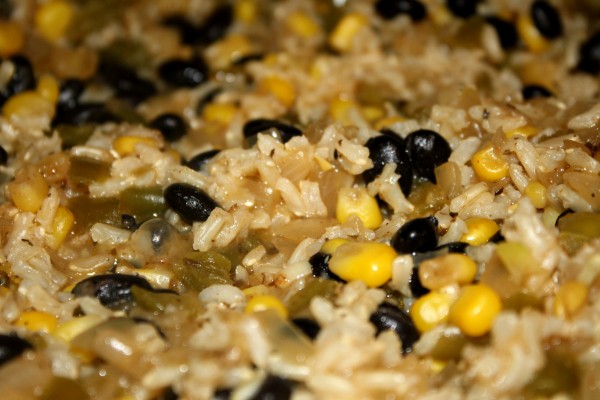
Black Beans and Rice Dish | Public Domain Image
Consider buying these cheap sources of protein (gram info from nutritiondata.self.com unless otherwise linked):

  • Eggs - 4 grams per large, fresh egg
  • Quinoa - 8 grams in a serving
  • Whey Protein Powder - 19 grams per 1 cup
  • Milk - 10 grams in a serving of nonfat, protein fortified
  • Cottage Cheese - 28 grams in 1 cup, lactose reduced
  • Greek Yogurt - 16 grams in 6 oz serving (I like Chobani Vanilla Nonfat with stevia added to it)
  • Beans and Rice - 9 grams in 1 cup of rice and beans combo
  • Soy Products  - 68 grams in 1 cup of soy nuts
  • Tempeh - 31 grams in 1 cup
  • Almonds 6 grams per ounce


And if you have to buy meat, then consider these two options before you go over to the Meat Department:
  • Canned Tuna in Water - 39 grams in 1 cup of solid white tuna in water, drained
  • Canned Mackerel - 44 grams in 1 cup of mackerel, jack, drained
  • Canned Sardines - 23 grams in 1 can of sardines packed in oil, drained
Which are Complete Proteins?

Just because a food item has lots of protein in it, you're not done.  Another consideration is whether or not it has all NINE essential amino acids in it, which then makes that food a "complete protein."

Of the items listed above, only the canned meat, the soy stuff, and the quinoa are complete proteins.  Which doesn't mean that the others aren't great, too .. just something to consider.

And yes, you can combine things to make a complete protein.  Rice and beans together, as shown above, make a complete protein.  So does smearing almond butter onto toast.

Here's the Thing: This Stuff Tastes Great.

Almonds?  They're great.  Raw, in salads, pureed into butter.  Major yum here.  Red beans and rice, or what we have here in San Antonio, pintos and rice?  Great stuff.

The greek yogurt is addicting, at least for me, when you add some stevia for sweetness and some pumpkin pie spice to the nonfat vanilla flavor.  Better than ice cream for dessert and I am not kidding you or deceiving myself.  Try it for yourself.

Quinoa?  I cook this in the microwave after learning about this on a Melissa D'Arabian show and it works great.  (Try her recipe which has 100 five star reviews at the time that I inserted this hyperlink for her lentil quinoa salad.)  And you can buy this seed, it's not a grain, made into all sorts of pasta shapes at World Market, among other places.  Elbow.  Spaghetti. 

You get the idea.  Simple living is just filled with all these discoveries.  You really do say "wow" a lot, and I'm still doing it after all these years.  It's fun!


February 1, 2012

TLC Book Tour: Book Review of New: Understanding Our Need for Novelty and Change

At the get-go, Dear Reader, let me get this business out of the way:  I was given a free copy of Winifred Gallagher's latest book, entitled New: Understanding Our Need for Novelty and Change by TLC Book Tours in exchange for my agreement to read and review the book here on Everyday Simplicity.  Disclosure done, here's my opinion:

This is another book coming out of publishing houses these days where journalists attempt to provide perspective, if not answers, to why things are the way they are right now.  Think Malcomb Gladwell.  Think Stephen Dubner.  Maybe Chris Anderson.

Here we have a journalist who has written extensively in the area of behavioral science, Winifred Gallagher, who offers her take on things.  From its publisher (Penguin Press):
[i]n today's fast-paced world, it's easy to feel overwhelmed by the mind-boggling number of new things-whether products, ideas, or bits of data-bombarding us daily. But adapting to new circumstance is so crucial to our survival that "love of the new," or neophilia, is hardwired into our brains at the deepest levels. Navigating between our innate love of novelty and the astonishingly new world around us is the task of New: helping us adapt to, learn about, and create new things that matter, while dismissing the rest as distractions. With wit and clarity, acclaimed behavioral science writer Winifred Gallagher takes us to the archaeological sites and neuroscience laboratories exploring our species' special affinity for novelty. ... As individuals, however, we vary in how we balance the sometimes conflicting needs to avoid risk and approach rewards. Some 15 percent of us are die-hard "neophiliacs" who are biologically predisposed to passionately pursue new experiences, and another 15 percent are "neophobes" who adamantly resist change. Most of us fall squarely in the spectrum's roomy middle range. Whether we love change, avoid change, or take the middle path, neophilia plays a crucial role in all of our lives.  No matter where we sit on neophilia's continuum, New shows us how to use it more skillfully to improve our lives.... This big-picture perspective has long been missing, and New will jump-start that discussion by offering the tools we need to control our love of the new-rather than letting it control us.

If you like this sort of thing, then you'll probably like this book.  It's receiving mostly good reviews (if you don't count NPR); moreover, it's got lots of fun facts and delves into all sorts of areas of interest: anthropology, archaeology, psychology, sociology, economics -- you can even find a reference to Charles Dickens here (Bleak House, which was interesting to discover since I'm reading Bleak House now).

Gallagher also provides suggestions on how to do things differently so life is better.  In her lingo, she's giving guidance on how to cope with all this new so that you control it and it doesn't control you.


Again, if you read these kind of books then you'll like this one.   


Related Posts Plugin for WordPress, Blogger...