Showing posts with label Starting to Simplify. Show all posts

March 13, 2012

Cheap Protein Sources to Consider When Planning Your Menu and Making Your Grocery List

For those living a voluntary simplicity lifestyle, being smart on the food budget is just part of maximizing the monthly disposable income.  However, in the years since I began living this way, I've seen more and more people that are simplifying their lives because they have to do it:  it's a financially necessity to live with less material stuff and a smaller budget.

These folk may not know how to cook, and they may be bummed that they have to cut back.  To them, I say - hey, there's a silver lining here!  There's fun in your future that you wouldn't have found if you hadn't had to start budgeting things.

Like learning all about cheap protein sources and using them in your menus.  There's some major good eating here as well as some very healthy things for you and yours, which someone who's eating out a lot or buying lots of prepackaged stuff or fast food take out is going to miss.

Cheap Sources of Quality Protein

The reason that you want to know cheap sources of protein is because protein can take the biggest chunk out of your monthly food budget.  Meat - beef, pork, chicken, fish - costs a lot and you buy it by the pound.  To get control of your food money for the month, it's a big target.

The silver lining is while you are buying protein options to beef, pork, chicken, fish that you are also getting some very nutritious stuff.  Stuff that can be lots better for you than the steak that you're not buying any more.
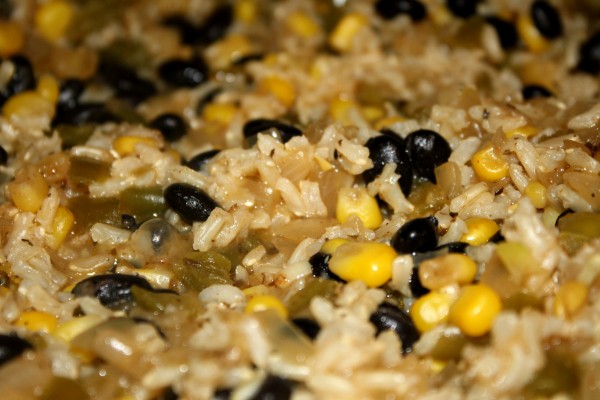

Black Beans and Rice Dish | Public Domain Image
Consider buying these cheap sources of protein (gram info from nutritiondata.self.com unless otherwise linked):

  • Eggs - 4 grams per large, fresh egg
  • Quinoa - 8 grams in a serving
  • Whey Protein Powder - 19 grams per 1 cup
  • Milk - 10 grams in a serving of nonfat, protein fortified
  • Cottage Cheese - 28 grams in 1 cup, lactose reduced
  • Greek Yogurt - 16 grams in 6 oz serving (I like Chobani Vanilla Nonfat with stevia added to it)
  • Beans and Rice - 9 grams in 1 cup of rice and beans combo
  • Soy Products  - 68 grams in 1 cup of soy nuts
  • Tempeh - 31 grams in 1 cup
  • Almonds 6 grams per ounce


And if you have to buy meat, then consider these two options before you go over to the Meat Department:
  • Canned Tuna in Water - 39 grams in 1 cup of solid white tuna in water, drained
  • Canned Mackerel - 44 grams in 1 cup of mackerel, jack, drained
  • Canned Sardines - 23 grams in 1 can of sardines packed in oil, drained
Which are Complete Proteins?

Just because a food item has lots of protein in it, you're not done.  Another consideration is whether or not it has all NINE essential amino acids in it, which then makes that food a "complete protein."

Of the items listed above, only the canned meat, the soy stuff, and the quinoa are complete proteins.  Which doesn't mean that the others aren't great, too .. just something to consider.

And yes, you can combine things to make a complete protein.  Rice and beans together, as shown above, make a complete protein.  So does smearing almond butter onto toast.

Here's the Thing: This Stuff Tastes Great.

Almonds?  They're great.  Raw, in salads, pureed into butter.  Major yum here.  Red beans and rice, or what we have here in San Antonio, pintos and rice?  Great stuff.

The greek yogurt is addicting, at least for me, when you add some stevia for sweetness and some pumpkin pie spice to the nonfat vanilla flavor.  Better than ice cream for dessert and I am not kidding you or deceiving myself.  Try it for yourself.

Quinoa?  I cook this in the microwave after learning about this on a Melissa D'Arabian show and it works great.  (Try her recipe which has 100 five star reviews at the time that I inserted this hyperlink for her lentil quinoa salad.)  And you can buy this seed, it's not a grain, made into all sorts of pasta shapes at World Market, among other places.  Elbow.  Spaghetti. 

You get the idea.  Simple living is just filled with all these discoveries.  You really do say "wow" a lot, and I'm still doing it after all these years.  It's fun!


January 3, 2012

Is Candy Spelling The Ultimate Simplifier? Maybe. Sorta. Kinda.

I don’t watch reality television much, but I surfed by this show yesterday – a repeat of HGTV’s Selling Spelling Manor

Wow.  Aaron Spelling’s monster mansion – Spelling Manor – has been sold by his widow and she’s moving to a Century City condo and getting rid of an amazing amount of stuff.  Anyone downsizing or who has downsized can find something with which to identify here. 

Admittedly, there’s much to be said that all of this is the Anti-Simplicity lifestyle.  True, so true.

However, this woman has undertaken a major life change and she’s gone through all those same pangs other simplifiers have:  letting go of the vase that has memories but needs to be tossed; boxing stuff for donation; giving away things that you’ve discovered in the attic stash to someone who’ll love them. 

Look, this country is in a depression and we all know it even if so many are too afraid to use the word.  Is it the Greater Depression?  I don’t think we know yet.

However, when so many are having to scale back and scale down, maybe knowing that Aaron Spelling’s widow Candy has vacated Spelling Manor to live in a condo the size of her former attic may help them feel they are not alone.

Just don’t ask about the slabs of pink Italian onyx going into the kitchen or the private swimming pool being built on the 42nd floor. 

Happy week, Dear Reader! 

February 28, 2011

Book to Read: The 100 Thing Challenge by Dave Bruno

There are more and more books becoming available that deal with aspects of simplifying one's life, and here's one that is worth your time to read:  The 100 Thing Challenge: How I Got Rid of Almost Everything, Remade My Life, and Regained My Soul by Dave Bruno - less than ten bucks as a paperback or via Kindle, or borrow it for free, like I did, from your local library. 

Here's how the publisher describes it:

In 2008, average American family man Dave Bruno decided to unhook himself from the intravenous drip of consumerism that fueled his life by winnowing all his personal possessions down to just 100 things. Little did he realize that he would be igniting a grassroots movement—soon after Dave embarked on his journey, media around the world took notice and others started to follow his lead.


A cause for pause, The 100 Thing Challenge is a response to the culture of materialism in America, one that has filled our lives with the constant and unsatisfactory desire for "more." Dave Bruno offers compelling anecdotes and practical advice to help readers live more meaningfully, simply by casting off the unnecessary "stuff" that clutters their lives. The 100 Thing Challenge is a golden opportunity to experience the positive changes that occur as you defiantly hop off the treadmill of consumerism.

Here's Why I Recommend This Book: 

If you want to simplify, there are lots of books out there with tips and tricks to get there - but following one man's personal experience really brings the message home.  Dave Bruno takes you through his process of changing his lifestyle and in doing so, challenges you to do the same.

As someone who's been living a simple life for several years now, more power to him.  And to you.

September 21, 2010

Hoarding: a Lifestyle in Opposition to Simple Living

I admit it, I do catch the occaional episode of Hoarding: Buried Alive on TLC TV.  I couldn't tell you when it airs, but I can tell you that everytime I watch the show, it makes me get up and dust or vacuum or do a load of laundry.  Something.  Maybe part of this is because (personal revelation, dear reader!) my mother, looking back, was obviously a hoarder.  So was my first husband's mother.  Wow, there's some food for thought.

Me?  I don't hoard.  Maybe living this lifestyle of voluntary simplicity in some way is reacting to that background - that's sounding plausible.  All I know is that organizing and simplifying seems smart and wise and it's a peaceful, joyful life.

Hoarding - The Reasons for It

As a result of the show, and as I pondered this personal connection with hoarders, I did go surfing around investigating hoarding.  I learned hoarding is a compulsion, with both psychological and physical components.  I learned that lots of professionals discuss anger and anxiety as emotions felt by haorders when faced with the idea of throwing anything away.

I'm not arguing with any of that -- from my experience, this all sounds true.  However, from my experience, there's something that isn't being discussed here.  From what I know of hoarding, it's a twisted way of dealing with a major loss.  It's a grief thing.  It's got a depression component and a thread of denial runs through it, but at its core - its a strange way of fighting against loss. 

Why share this with you, Dear Reader?  Because There's Simplifying Lesson Here for Us All

In the process of simplifying your life - be it downsizing, going green, living frugally or living slowly or moving to a one-income household, or expatriating - and there are lots of varieties of simple living, some of those hoarder reactions seem familiar.

There's the stuff.  Stuff you don't want to get rid of, even if you don't need it and will never use it.  There are all those boxes of memories - the kid's school papers, your old college textbooks - that need to be culled. 

Letting go of stuff is hard.  It involves loss.  Simplifying is hard.  There's an emotional component to the process.  It's worth it, but in no way is it easy.  Simplifying your life may not be simple at all. 

God bless you, Dear Reader.

September 1, 2010

FOXBusiness Offers 7 Steps to a Single Income Family: Is Downsizing Becoming Acceptable?

Today, FoxBusiness has a great article entitled, "7 Steps to Becoming a One-Income Family" that really does give substantive help in moving from a two-income household to a one-income family.

What I like best is the end of the article, where the expert points out that American society predominates with instant gratification and a pressure to spend - but that the ability to simplify things is doable, and he appears to say there is power in it.

Which those of us who have been simplifying voluntarily for years know - and have been sharing with anyone who cares to listen, for years now.

Power. And freedom.

Maybe if the main stream media is writing articles like this, frugal living and voluntary simplicity won't suffer such a stigma in the future. Downsizing is cool now? Wow. That's great.

March 14, 2010

Peaceful Places - Find Your Own Place of Peace

Living a simple life does not mean living a slow, sluggardly one.  For instance, no one lives a life more simple that the Amish - and they're busy from 5 am to bedtime.  (By the way, lots of good info on the Amish has been collected by Amish,Net though the Amish themselves, of course, aren't on the web.)

Living a peaceful life takes some work.

There's the daily check on what's going on -- strife can sneak in when you least expect it.  Letting go of anger, forgiving those who've done wrong to you (which doesn't mean you're a doormat allowing repetitive abuse, by the way), overcoming frustration, are all things that are continual tasks when you're trying to move forward in life. 

Having a personal spot, a place of peaceful surroundings, can be a great big help. 

Long ago, back when I was living the Materialistic Lifestyle, if you'd asked me about a peaceful place I would have responded that for me, it was the beach and that I went there a couple of times a year.  A good friend felt the same way, but the answer was the Rocky Mountains. 

In stressful times, having these vacation spots as the only place that you can find a peaceful spot isn't enough  because they are too hard to reach, too far away.  You need to know Your Place of Peace in advance of a Stressful Time (because, Dear Reader, they are periodically guaranteed), that you can access almost immediately.  You need a nearby place of peace that you can incorporate into your routine.  

What's a Personal Place of Peace?

As a Christian, I obviously include prayer as one of the big things that happens in a place of peace.  However, it's more than a prayer spot. 

A personal place of peace is an oasis from everything else in your life where you can get some distance, mentally as well as spiritually, and hopefully, some perspective. 

It's a place where there is no additional input -- other than beauty -- which allows you to gain control over your emotions, get a stress break, and put a halt to running from problems or reacting instead of being proactive about things.  You're there alone, by the way -- a golf game or a drink at a bar are NOT places of peace. 

Also, it needs to be close to home or work, where you can reach it within 10 to 15 minutes by car or foot.  Sometimes, your place of peace can help you just by knowing you have this Secret Oasis nearby -- imagining it during a meeting, a traffic jam, or a family fight can really, really help. 

What You Take With You

Maybe you take a Bible, maybe you bring a Journal.  Maybe you listen to music (but it needs to be appropriate, not distracting).  Books that bring you encouragement and supportive thoughts can be helpful (from Joel Osteen to Erma Bombeck to Shakespearean Sonnets, this is a personal thing).  Sure, you can have something to drink or eat (if you're there awhile, this may be a prerequisite, or all you'll be thinking about is how great a cheeseburger sounds). 

Where do You go?

Ah, the big question.  You, Dear Reader, have to go FIND your personal place of peace.  Consider yourself on a mission.  It can be a public park, a garden, a museum, the rooftop of a skyscraper ... it could be the zoo.  I have a friend who has a zoo membership, and regularly leaves his office to walk the zoo just to think and pray and get "re-grounded."

How he can eat there (he brings a snack) is beyond me because the wild animal poop smell cannot be escaped no matter how great the San Antonio Zoo is about keeping things tidy. Which just goes to show, one person's place of peace is another person's place of distracting smelly elephant poop. 

Worthy of note: this is a man who is a position of tremendous power, a Big Kahuna guy, and he makes a lot of jokes about how he escapes one zoo by going to another.  It works for him.

Drives are good, they may start out with that fantasy of just driving and driving until you hit a Coast, East or West, but for peaceful places they aren't the best because you do have to be safe while driving a vehicle that weighs around 3500 lbs.  A place of peace can involve crying, or yelling, the release of emotion -- and you need to be free to allow those things to escape you without being worried about Big Rigs on the road.  Better: a pretty drive that leads you to a pretty place.  Maybe a great view -- you can stay in the car, just don't keep driving forever. 

Places of Peace are Private.  One last thing, Dear Reader -- when you've found your place of peace, don't blabber about it to everyone.  Keep it your secret oasis, it's part of its power: knowing that you're in a safe spot for a mental and spiritual breather where you won't be interrupted is important.  Plus, it's fun to have your own SECRET PLACE in the world. 

Image:  Female African Bush elephant (named “Duchess”) at Paignton Zoo, Paignton, Devon. Wikimedia Commons, public domain.

March 11, 2010

Joyce Meyer Talks Simplicity This Week

Joyce Meyer's televised broadcast this morning was the first of a two-parter dealing with Simple Living.  The title of the show today is "Simple Prayer and Simple Living, Part 1" and it's well worth your time.  (Her book, The Power of Simple Prayer, is being offered with a set of DVDs this week as a special offer, and you can read a sample chapter for free on her site.)

Today's show is very funny.  Joyce Meyer always makes me laugh.  Today, she talks about letting that load of clothes build up, and then when you carry it to the washer, you realize you've already left a load setting in there.  Except when she talks about doing this (I've done it, how about you?), it's hilarious.  She talks about the time that she started out with a simple invite to four friends after church, come over next week for hot dogs, and turning that into a steak BBQ for 32.  Again, it's really funny when you hear her telling stories on herself.

Really good thing here -- she makes an excellent example for how simplicity - simple living - isn't always the same as frugal living.  They aren't synonimous terms, and it's really clear here, in how she talks about taking the complications out of your daily life, for a higher quality of living.

Another really good thing -- her book on simplifying.  There's a separate post on that one, it's really good. 

January 18, 2010

5 Baby Steps in Simplifying Your Life

There may be those who make sudden and drastic lifestyle changes, quiting jobs and selling houses, moving forward rapidly in their pursuit of a dream.  For most folk, simplifying life isn't that speedy or smooth.  It really is taking a step at a time, one day at a time. 

Here are five baby steps toward simple living:

1.  Cut the splurge buys.  Yes, this means eating breakfast at home and not buying fancy coffee.  No Starbucks except as a special treat. 
2.  Organize your weekly errands. Make a list of your errands (bank, post office, etc.) and do them all at once, planning your route to maximize your time and minimize your fuel expense. 
3.  Investigate free events in your community.  These can be rewarding for members of the whole family, and lotsa fun.  Check out the local paper and the public library website.
4. Respect your Sundays.  For Christians, Sunday means church and usually, a nice lunch afterwards.  For everyone, there is wisdom in taking this one day of the week as a day of rest.  The big family meal on Sunday is a wonderful thing, everyone gets a chance to catch up with the others.  Especially when everyone works together in cooking the food. 
5. Rethink fashion.  Scrutinize your wardrobe and ask yourself how much you really need designer togs and to the extent that you do, why?  Simplifying life means stepping aside from the Fast Track, the Rat Race, the Keeping Up with the Jones approach to things.  This doesn't mean sacrificing quality, it means taking your fashion sense to a whole new level. 

January 1, 2010

New Years Simplicity Resolutions - 2010

First things first, I think Lisa Scottoline has it right -- she's doing "unresolutions" again this year, and in her usual funny way, she's made a great point about this annual tradition.  Resolutions can be negative, even mean-spirited.  Never a good thing, but especially during times like these we all need to be as positive and upbeat as possible -- helps us to keep moving forward. 

Here are some suggestions for resolutions in simple living this year: 

1.  I will get outside almost very day - for a walk, a run, maybe just to sit in the backyard and watch birds fly. 

2.  I will thank God each morning that I'm here - I've got another day of living.  And mean it.

3.  I'll find things to laugh about -- I'm gonna look for it 24/7 and laugh long and loud when I find it. 

4.  I'll find bits of beauty in the world around me.  Maybe it's in a smile, or how the rooms fill with the aroma of coffee in the morning. 

December 28, 2008

Books on Simplicity Rising in Popularity (Though They're Calling it Frugality): Here's a Reading List

Over at the Salt Lake City Tribune, they're sharing an article written by Susan Carpenter of the Los Angeles Times, "Books: Concept of frugality makes comeback - Salt Lake Tribune". And guess what? It's all about that classic simplicity tome, Your Money or Your Life: Transforming Your Relationship with Money and Achieving Financial Independence by Joe Dominguez and Vicki Robin.

Yep, the one written about 40 years ago ... although it has been revised and updated for today's market. Of course, they're confusing frugality and simplicity: leading a simple life is a lifestyle that is far from lack (which the term "frugality" might suggest). Simplify your lifestyle and enrich your life - simplicity isn't about loss, it's about gain.

If you're interested in reading more about living a simple life, here are some Simplicity books worth your time:

Finding Happiness by Christopher Jamison

100 Ways to Simplify Your Life by Joyce Meyer

Choosing Simplicity: Real People Finding Peace and Fulfillment in a Complex World by Linda Breen Pierce

Living the Simple life: A Guide to Scaling Down and Enjoying More by Elaine St. James

Voluntary Simplicity, Revised Edition: Toward a Life that is Inwardly Simple, Outwardly Rich by Duane Elgin

The Simple Living Guide by Janet Luhrs

The Complete Idiot's Guide to Simple Living

Affluenza: The All-Consuming Epidemic by John de Graaf, David Wann, Thomas H. Naylor

Self-Reliance by Ralph Waldo Emerson

Walden by Henry David Thoreau

Approval Addiction: Overcoming Your Need to Please Everyone by Joyce Meyer

For more, check out Books to Read at Everyday Simplicity.

July 9, 2008

Is Being Frugal Becoming Trendy?

According to MSNBC, the answer is "yes," ("Is Frugal The New Black?") but only because the economy is causing belts to tighten around the country.

I suppose this is good news for everyone involved in simplifying their lives, although it may mean more competition at estate sales and thrift stores for the good finds ... but I think it forgets a large segment of the Simplicity Population.

There are many of us who have chosen to simplify our lives because of the quality of life that results from this lifestyle change. It's not all about the money, and I think this may make a big difference in how happy you are with your new frugality.

For example, this morning I awoke to the sound of the 5:30 am cannon, which I'm told is the same cannon that Fort Sam soldiers used to start the day when Geronimo was still being held in their Quadrangle. A cool breeze was coming through the windows, and I could smell the honeysuckle.

It was a nice way to start a great day. Never once did I consider that I didn't have the air conditioner going, and I didn't jump up and rush to anywhere after slamming the alarm clock off.

It did, however, make me stop and thank God for how I'm living now, versus how I lived Back Then, and it's that feeling of joy, for lack of a better word, that I find is missing from the MSNBC report.

For more information:

What Is Simplifying? Should You Do It?

Declaration Of Independence From Overconsumption

April 2, 2008

What is Simplifying? Should You Do It?

Today’s news is filled with scary stories about the cratering sub-prime lending market, the dollar’s decline, and the plunging Dow. This has got a lot of people pondering ways to cut back on their spending, getting ready for a severe recession that seems more and more inevitable.

Tightening your money belt is a good thing, it’s a smart strategy. However, it’s very different from simplifying your life. Cutting back is painful; simplifying is freeing and fun. Maybe now more than ever, it’s time to think about simplicity.

Simplifying isn’t a new concept: the Shakers were propounding the benefits of living a simple life over 150 years ago. Janet Luhrs’ book, The Simple Living Guide, has had steady sales since its debut in 1998, and this April will mark the 14th anniversary of Vicki Robin’s famous speech to the United Nations, “A Declaration of Independence from Overconsumption.”

What is simplifying? It’s going against the materialistic mainstream and proactively living a life that you have consciously defined for yourself. There are many reasons for simplifying, and there are many different types of simplifiers.

For some, simplifying life means reducing stress for health reasons, for others it’s a social justice or anti-consumerism issue. Simplifiers can be as straight-forward as families transforming into one-income households so their kids can have a full-time parent at home, as well as someone deciding to buy only organic or locally-grown produce. They can also be as multifaceted as environmental activists, seeking to minimize their consumption of fossil fuels by living off the grid along with those involved in The Compact, where members have committed to buy absolutely nothing new for one full year.

Ed Begley, Jr., of the cable television show “Living With Ed,” is a simplifier. So is Julia Roberts, who took time off from her career to stay at home with her young children.

If the news of an impending recession has you pondering your way of life, and wondering if perhaps there is a better way, then you may be interested in simplifying. Should you choose to do so, know that it has tremendous benefits: there is a surprising sense of freedom with each step you take, and there is suddenly more time to do the things you care about. However, it’s not for the faint-hearted: you’ll have discouraging friends and family who will not understand this change in attitude, and you’ll have moments of being overwhelmed at the undertaking.

For those who have taken steps to simplifying their lives, though, it’s been worth all their efforts. Life truly is better without the call of the mall.

If you’re interested in learning more, check out:

1. In Print

Choosing Simplicity: Real People Finding Peace and Fulfillment in a Complex World by Linda Breen Pierce. Stories of those who have downsized their lives, relates their experiences and whether or not they regret the change.

Your Money or Your Life: Transforming Your Relationship with Money and Achieving Financial Independence by Joe R. Dominguez and Vicki Robin. Financial guide, a landmark in the Simplicity movement.

Living the Simple Life : A Guide to Scaling Down and Enjoying More
by Elaine St. James. Good, practical tips (cancel the newspaper subscription, eat at home).

Voluntary Simplicity, Revised Edition: Toward a Life That is Inwardly Simple, Outwardly Rich by Duane Elgin. History of the movement, discussion of spiritual motivations behind downsizing.

The Simple Living Guide by Janet Luhrs. Must-read; describes all variety of lifestyles within the "voluntary simplicity" world.


2. Online

Everyday Simplicity (http://everydaysimplicity.blogspot.com)
The Simple Living Network (http://www.simpleliving.net/main)
Simple Living America (http://simplelivingamerica.blogspot.com)

January 22, 2008

Starting to Simplify: Step 1 - Start Cooking at Home

Lots of folk are in the process of simplifying their lives, and from the looks of today's economy, a lot more are going to be revamping their lifestyles - maybe as a necessity, as much as a proactive choice.

What if you're interested in changing your life, taking control and simplifying things, but you're not sure where to begin?

Perhaps the easiest place to start is to begin preparing your food at home. This means bringing your lunch to work, and cooking meals at home - not eating out, not grabbing fast food.

It's easier than you think, it's fun, it's a stress-reducer, it's healthier, and it's a great family ritual to get everyone communicating with each other at the table. Plus, you will be amazed at the amount of money you save.

Start slowly, Rome wasn't built in a day. Take your lunch to work on odd-numbered days, or cook a big meal on Sunday that can serve as yummy leftovers during the week.

For more guidance, check out these posts:

How to Cook - 1
How to Cook - 2
How to Cook - 3: Slow Cookers
Menu Planning 101
Menu Planning 102
How to Cut Up a Whole Chicken
How to Fillet a Whole Fish
Cleaning Burnt Pans
Related Posts Plugin for WordPress, Blogger...